
Professional Certificate in Advanced Calculus Methods for Signal Processing
Master advanced calculus techniques to optimize signal processing algorithms and enhance engineering problem-solving capabilities.
Professional Certificate in Advanced Calculus Methods for Signal Processing
Programme Summary
This rigorous programme equips senior engineers and data scientists with the sophisticated mathematical frameworks essential for modern signal processing applications. It targets professionals seeking to bridge the gap between theoretical mathematics and practical engineering challenges in telecommunications, audio engineering, and biomedical imaging. The curriculum delivers an intensive exploration of Fourier analysis, Laplace transforms, and z-transforms, ensuring participants master the underlying principles governing linear time-invariant systems. Students engage with complex variable theory and differential equations to decode intricate signal behaviours that standard computational tools often obscure. This advanced training prepares candidates to handle high-frequency data streams and non-stationary signals with precision and confidence.
Learners acquire the ability to design optimal filters and analyse system stability using rigorous analytical techniques rather than relying solely on black-box software solutions. Participants develop proficiency in solving partial differential equations that model wave propagation and heat transfer within physical systems. The course emphasises the derivation of convolution theorems and their application in digital signal processing algorithms. Students learn to interpret spectral density functions and apply windowing techniques to mitigate leakage effects in finite-length data sets. This deep technical grounding enables practitioners to innovate in algorithm development and improve signal-to-noise ratios in noisy environments.
Graduates emerge as strategic assets capable of leading R&D initiatives in sectors demanding high-fidelity data interpretation and real-time processing capabilities. The certification distinguishes holders in competitive job markets by validating their mastery of advanced calculus beyond standard engineering curricula. Employers value these experts for their capacity to troubleshoot complex system failures and optimise
Learning Outcomes
This rigorous Professional Certificate equips engineering professionals and data scientists with the sophisticated mathematical frameworks essential for modern signal processing. By bridging the gap between abstract theoretical calculus and practical engineering applications, the programme empowers participants to tackle complex problems in telecommunications, medical imaging, and autonomous systems. The curriculum moves beyond standard differentiation and integration, delving into the nuanced mechanics of partial differential equations, Fourier transforms, and Laplace methods. Participants will explore how these advanced techniques facilitate the decomposition, analysis, and reconstruction of signals in both time and frequency domains.
The value of this certification lies in its direct applicability to high-stakes industrial challenges. Graduates learn to model non-linear systems with precision, optimise filter designs for noise reduction, and enhance compression algorithms for efficient data transmission. Through intensive case studies and computational laboratories, students apply these methods to real-world datasets, ensuring they possess the technical agility required by leading technology firms. The programme emphasises not only theoretical mastery but also the implementation of these methods using industry-standard software tools, fostering a deep intuitive understanding of signal behaviour.
Upon completion, alumni are well-positioned for senior roles such as Senior Signal Processing Engineer, Research Scientist, or Algorithm Developer within sectors ranging from aerospace to fintech. These professionals drive innovation by developing robust systems for radar detection, speech recognition, and high-frequency trading analysis. The certificate serves as a distinct marker of expertise, demonstrating to employers a commitment to technical excellence and advanced analytical capability. It opens doors to leadership positions where mathematical rig
Programme Features
Industry-Aligned Curriculum
Developed with industry leaders for job-ready skills
Globally Recognised Certificate
Recognised by employers across 180+ countries
Flexible Online Learning
Study at your own pace with lifetime access
Instant Access
Start learning immediately, no application process
Constantly Updated Content
Latest industry trends and best practices
Career Advancement
87% report measurable career progression within 6 months
Course Modules
- Complex Analysis Foundations: Reviews analytic functions, contour integration, and residue theory essential for frequency domain analysis.: Fourier Transform Theory: Examines continuous and discrete Fourier transforms, convolution, and spectral density estimation techniques.
- Laplace and Z-Transforms: Analyzes system stability, transfer functions, and region of convergence for linear time-invariant systems.: Partial Differential Equations: Solves wave and diffusion equations using separation of variables and eigenfunction expansions.
- Linear Algebra for Signals: Applies matrix decompositions, singular value decomposition, and least squares methods to signal reconstruction.: Numerical Methods and Optimization: Implements gradient descent, Newton-Raphson methods, and numerical integration for algorithm design.
What's Included in This Programme
Here is what you get when you enrol with LSBR London
Programme Facts
Audience: Engineering professionals seeking advanced signal processing expertise.
Prerequisites: Solid foundation in undergraduate mathematics and calculus.
Outcomes: Master complex analytical techniques for modern signal applications.
Ready to advance your career?
Join thousands of professionals who have transformed their careers with LSBR London. Enrol today and start learning immediately.
Why Study This Programme
Pursuing the Professional Certificate in Advanced Calculus Methods for Signal Processing represents a strategic investment for engineers seeking to distinguish themselves in an increasingly competitive technical landscape. This rigorous programme equips practitioners with the mathematical sophistication required to tackle complex signal analysis challenges that standard curricula often overlook.
The curriculum delivers mastery over integral transforms and differential equations, enabling professionals to optimise filter design and noise reduction algorithms with precision. This technical depth directly translates into improved system performance and reduced latency in real-time applications.
Graduates acquire the ability to model stochastic processes accurately, a skill critical for enhancing the reliability of communication systems and radar technologies. Such expertise positions candidates for senior roles where robust algorithmic stability is paramount.
The certification provides a formal credential that validates advanced analytical capabilities to prospective employers. This distinction often accelerates career progression, opening doors to leadership positions within research and development departments.
Participants engage with case studies drawn from industry leaders, fostering practical problem-solving skills that bridge the gap between theoretical mathematics and commercial implementation. This practical orientation ensures immediate applicability upon return to the workplace.
By securing this qualification, professionals demonstrate a commitment to continuous improvement and technical excellence. The programme cultivates a mindset capable of navigating the nuanced demands of modern signal processing, ensuring long-term relevance and adaptability in the face of rapid technological evolution.
"This programme gave me the confidence and credentials to secure a senior role. Highly recommend LSBR London."
— Sarah M., United Kingdom
Course Brochure
Download our comprehensive course brochure with all details
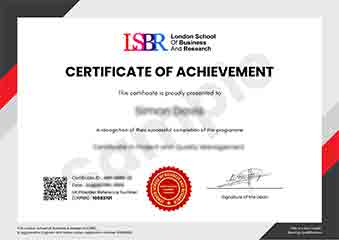
Sample Certificate
Preview the certificate you'll receive upon successful completion of this program.
Get Course Info
Receive the full course guide, pricing details, and enrolment instructions directly in your inbox.
Check your inbox!
Course details have been sent to your email.
Get Your Employer to Sponsor This Programme
Many employers offer professional development budgets. We make it easy for your company to invest in your growth with corporate invoicing and bulk enrolment options.
Email Template for Your Manager
Dear [Manager's Name],
I would like to request sponsorship for the Professional Certificate in Advanced Calculus Methods for Signal Processing programme offered by LSBR London - Executive Education.
The programme costs $149 (one-time) and can be completed in 3-4 weeks alongside my regular duties.
Key benefits to our team:
- Immediately applicable skills
- Globally recognised certificate
- Corporate invoice available
Best regards,
[Your Name]
What Our Students Say
Hear from our students about their experience with the Professional Certificate in Advanced Calculus Methods for Signal Processing at LSBR London - Executive Education.
Sophie Brown
United Kingdom"The rigorous focus on Fourier transforms and convolution provided a solid theoretical foundation that immediately translated into better signal filtering techniques. I now feel confident applying these advanced calculus methods to real-world audio processing challenges, which has significantly boosted my technical credibility in the field."
Ashley Rodriguez
United States"Mastering the advanced calculus techniques in this course allowed me to optimize signal filtering algorithms with unprecedented precision, directly addressing complex challenges in my current role. This deep technical proficiency not only streamlined our data processing pipeline but also positioned me for a promotion to lead engineer by demonstrating my ability to handle high-level mathematical modeling."
Oliver Davies
United Kingdom"The logical progression of modules made complex signal processing concepts accessible and easy to integrate into my existing knowledge base. This structured approach significantly enhanced my ability to apply advanced calculus techniques to real-world engineering challenges, directly boosting my professional confidence."
Your Certification Journey
Four simple steps from enrolment to your globally recognised certificate
Enrol Online
Complete your enrolment in under 2 minutes with secure checkout
Start Learning
Get instant access to all course materials and start at your own pace
Complete Modules
Work through the curriculum with expert support available throughout
Get Certified
Receive your LSBR London certificate recognised across 180+ countries
LSBR London by the Numbers
Join a global community of professionals advancing their careers
Students Enrolled
Countries Represented
Average Rating
Career Progression