
Advanced Certificate in Biosensors and Bioelectronics: Principles and Applications
Gain hands-on expertise in biosensors and bioelectronics, enhancing your skills for innovative biomedical and environmental applications.
Advanced Certificate in Biosensors and Bioelectronics: Principles and Applications
Programme Overview
This course targets professionals and students in engineering, biology, and related fields. It's for those who want to dive deep into biosensors and bioelectronics. You will first gain a solid foundation in the principles of biosensors. Then, you'll explore cutting-edge applications in healthcare, environmental monitoring, and more.
First, you'll learn about the core concepts of bioelectronics. Next, you'll grasp how to design and develop biosensors. Finally, you'll apply this knowledge to real-world problems. By the end, you'll be equipped to innovate in this dynamic field.
What You'll Learn
Unlock the future of healthcare and technology with our Advanced Certificate in Biosensors and Bioelectronics: Principles and Applications. First, dive deep into the fundamentals. Learn how biosensors work, from sensing mechanisms to signal processing. Next, explore cutting-edge applications. Discover how bioelectronics revolutionize medicine, from wearable devices to implantable sensors.
Enroll today, to gain hands-on experience. Work with state-of-the-art equipment. Develop your own biosensor projects. Moreover, engage with industry experts. Benefit from guest lectures and workshops. Meanwhile, enjoy flexible learning options. Attend classes online or on-campus. Connect with a global community of innovators.
Moreover, boost your career prospects. Open doors to roles like biomedical engineer, research scientist, or bioinstrumentation specialist. Lastly, make a real-world impact. Contribute to breakthroughs in disease diagnosis, environmental monitoring, and beyond.
Join us. Shape the future of bioscience and technology. Enroll now!
Programme Highlights
Industry-Aligned Curriculum
Developed with industry leaders to ensure practical, job-ready skills valued by employers worldwide.
Expert Faculty
Learn from experienced professionals with real-world expertise in your chosen field.
Flexible Learning
Study at your own pace, from anywhere in the world, with our flexible online platform.
Industry Focus
Practical, real-world knowledge designed to meet the demands of today's competitive job market.
Latest Curriculum
Stay ahead with constantly updated content reflecting the latest industry trends and best practices.
Career Advancement
Unlock new opportunities with a globally recognized qualification respected by employers.
Topics Covered
- Fundamental Principles of Biosensors: Introduction to biosensors and their basic operating principles.
- Transducer Technologies: Exploration of different transducer technologies used in biosensors.
- Biomolecular Recognition Elements: Study of biological recognition elements and their integration with transducers.
- Bioelectronic Interfaces: Understanding the interfaces between biological systems and electronic devices.
- Signal Processing and Data Analysis: Techniques for processing and analyzing signals from biosensors.
- Applications of Biosensors and Bioelectronics: Investigation of various applications in healthcare, environmental monitoring, and more.
Key Facts
Audience:
This course welcomes professionals and students from diverse fields.
Includes bioscience, engineering, and related disciplines.
Beginners in biosensors seeking foundational knowledge first.
Prerequisites:
A background in science or engineering first.
Familiarity with biology and electronics is a plus.
No specific software or hardware is needed beforehand.
Outcomes:
Gain a comprehensive understanding of biosensors and bioelectronics first.
Learn to design and develop biosensor systems next.
Apply knowledge to real-world applications thereafter.
Understand the ethical implications of biosensor technology finally.
Why This Course
Gain Cutting-Edge Skills: First, the certificate equips learners with modern skills. It covers the latest in biosensors and bioelectronics. Thus, graduates are ready for today’s jobs.
Enhance Career Prospects: Next, this program boosts job opportunities. Many industries need experts in biosensors. Therefore, certification opens doors. Furthermore, it prepares learners for roles in healthcare, research, and technology.
Join a Vibrant Community: Finally, learners join a supportive network. They connect with peers and experts. Thus, they build a strong professional network. This support continues even after the program ends, fostering lifelong learning.
Programme Title
Advanced Certificate in Biosensors and Bioelectronics: Principles and Applications
Course Brochure
Download our comprehensive course brochure with all details
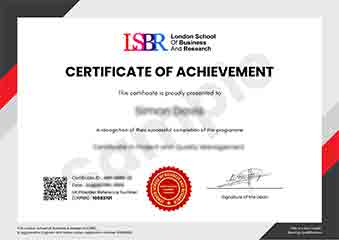
Sample Certificate
Preview the certificate you'll receive upon successful completion of this program.
Pay as an Employer
Request an invoice for your company to pay for this course. Perfect for corporate training and professional development.
What People Say About Us
Hear from our students about their experience with the Advanced Certificate in Biosensors and Bioelectronics: Principles and Applications at LSBR London - Executive Education.
Charlotte Williams
United Kingdom"The course material was incredibly comprehensive, covering everything from fundamental principles to cutting-edge applications in biosensors and bioelectronics. I gained practical skills that I can directly apply to my research, making me more confident in my ability to design and implement bioelectronic systems."
Brandon Wilson
United States"The Advanced Certificate in Biosensors and Bioelectronics has significantly enhanced my understanding of industry-relevant technologies, enabling me to develop practical skills that have directly contributed to my career advancement in biomedical engineering. The course's focus on real-world applications has made me more confident in designing and implementing biosensor systems, opening up new opportunities in research and development."
Anna Schmidt
Germany"The course structure was exceptionally well-organized, with each module building seamlessly upon the last, which made complex topics in biosensors and bioelectronics much more digestible. The comprehensive content not only deepened my understanding of theoretical principles but also provided practical insights into real-world applications, significantly enhancing my professional growth in the field."