
Advanced Certificate in Computational Methods for Manifold Analysis
Master advanced computational techniques to analyze complex manifolds, enhancing data insights and driving innovative research outcomes.
Advanced Certificate in Computational Methods for Manifold Analysis
Programme Summary
The Advanced Certificate in Computational Methods for Manifold Analysis targets senior data scientists, quantitative analysts, and research engineers who require rigorous mathematical frameworks for high-dimensional data processing. This intensive curriculum bridges the gap between abstract differential geometry and practical algorithmic implementation, focusing on the extraction of intrinsic structures from complex datasets. Participants engage with core concepts such as Riemannian metrics, geodesic distances, and spectral embedding techniques, ensuring a robust theoretical foundation. The programme is designed for professionals working within financial modelling, bioinformatics, or artificial intelligence sectors where traditional Euclidean methods fail to capture non-linear relationships.
Learners will master the implementation of manifold learning algorithms, including Isomap, Locally Linear Embedding, and t-SNE, using Python and R libraries. The coursework demands proficiency in numerical linear algebra and stochastic optimisation, enabling students to handle sparse and noisy data effectively. Participants develop the ability to visualise high-dimensional spaces while preserving local and global structural properties, a critical competency for interpretability in machine learning models. Rigorous assessment through coding projects ensures that graduates can deploy these methods in production environments with computational efficiency and statistical validity.
Completion of this certificate significantly enhances career prospects in advanced analytics roles, particularly within fintech and pharmaceutical research firms. Graduates gain a competitive edge by offering solutions that reduce dimensionality without losing critical information, directly impacting model accuracy and resource efficiency. This specialised expertise allows professionals to lead complex data initiatives, driving innovation in predictive modelling and pattern recognition. Employers value this
Learning Outcomes
This rigorous Advanced Certificate equips senior professionals and researchers with the sophisticated mathematical tools required to decipher complex, high-dimensional data structures. In an era where information volume exceeds traditional analytical capacity, the ability to model data as geometric manifolds offers a decisive competitive advantage. Participants gain mastery over non-linear dimensionality reduction, topological data analysis, and differential geometry, transforming abstract theory into actionable business intelligence.
The curriculum prioritises practical application alongside theoretical depth. Students engage with cutting-edge algorithms such as Isomap, Laplacian Eigenmaps, and Persistent Homology, utilising Python and R environments to process real-world datasets. Case studies drawn from finance, healthcare, and engineering illustrate how manifold learning uncovers hidden patterns that linear methods invariably miss. By focusing on the intrinsic geometry of data, learners develop the capacity to reduce noise, identify clusters, and predict trends with unprecedented precision.
Graduates emerge capable of leading data strategy initiatives within multinational corporations, financial institutions, and research laboratories. They apply these computational methods to optimise supply chains, detect fraudulent transactions, and accelerate drug discovery processes. The programme’s emphasis on robust statistical inference ensures that insights are not only mathematically sound but also commercially viable.
Career pathways extend beyond traditional data science roles into strategic advisory positions, quantitative analysis, and product development leadership. Alumni frequently assume roles as Head of Data Science, Chief Analytics Officer, or Senior Research Scientist. This qualification signals a rare combination of mathematical rigour and strategic acumen, distinguishing holders in a crowded
Programme Features
Industry-Aligned Curriculum
Developed with industry leaders for job-ready skills
Globally Recognised Certificate
Recognised by employers across 180+ countries
Flexible Online Learning
Study at your own pace with lifetime access
Instant Access
Start learning immediately, no application process
Constantly Updated Content
Latest industry trends and best practices
Career Advancement
87% report measurable career progression within 6 months
Course Modules
- Differential Geometry Foundations: Reviews the essential mathematical structures of manifolds, tangent spaces, and curvature.: Discrete Differential Geometry: Introduces discretization techniques for representing smooth manifolds using meshes and point clouds.
- Manifold Learning Algorithms: Examines dimensionality reduction techniques such as Isomap, LLE, and Laplacian Eigenmaps.: Geometric Deep Learning: Explores neural network architectures designed to operate directly on non-Euclidean data structures.
- Topological Data Analysis: Covers persistent homology and Mapper algorithms for extracting shape features from complex datasets.: Applications in Computational Science: Demonstrates real-world implementations in computer vision, robotics, and biomedical imaging.
What's Included in This Programme
Here is what you get when you enrol with LSBR London
Programme Facts
Audience: Senior data scientists and quantitative analysts seeking advanced methodological expertise.
Prerequisites: Proficiency in Python programming and foundational knowledge of differential geometry.
Outcomes: Mastery of manifold learning techniques for high-dimensional, complex data structures.
Ready to advance your career?
Join thousands of professionals who have transformed their careers with LSBR London. Enrol today and start learning immediately.
Why Study This Programme
The 'Advanced Certificate in Computational Methods for Manifold Analysis' represents a strategic investment for professionals navigating the complexities of high-dimensional data. This programme bridges the gap between abstract mathematical theory and practical application, equipping learners with the technical proficiency required to extract meaningful insights from intricate datasets. Such capability is increasingly vital in sectors ranging from financial modelling to biomedical research, where traditional analytical tools often fail to capture non-linear relationships.
The curriculum delivers rigorous training in dimensionality reduction techniques, enabling practitioners to visualise and interpret complex structures efficiently. This skill directly enhances decision-making accuracy by revealing hidden patterns within large-scale data sets, thereby providing a competitive advantage in data-driven environments.
Participants acquire advanced proficiency in Python-based libraries tailored for manifold learning, such as UMAP and t-SNE. Mastery of these tools ensures immediate applicability in the workplace, allowing professionals to integrate sophisticated analytical methods into existing workflows without significant downtime or additional training requirements.
The certificate fosters a deeper understanding of topological data analysis, which is crucial for robust outlier detection and anomaly identification. This expertise is highly valued in risk management and quality assurance roles, where identifying subtle deviations can prevent significant operational failures.
Graduates emerge with a distinct professional credential that signals specialised expertise to employers. This differentiation supports career progression into senior analytical roles, demonstrating a commitment to continuous learning and technical excellence in an increasingly digital economy.
"This programme gave me the confidence and credentials to secure a senior role. Highly recommend LSBR London."
— Sarah M., United Kingdom
Course Brochure
Download our comprehensive course brochure with all details
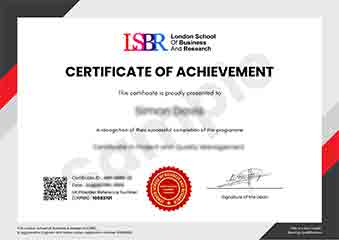
Sample Certificate
Preview the certificate you'll receive upon successful completion of this program.
Get Course Info
Receive the full course guide, pricing details, and enrolment instructions directly in your inbox.
Check your inbox!
Course details have been sent to your email.
Get Your Employer to Sponsor This Programme
Many employers offer professional development budgets. We make it easy for your company to invest in your growth with corporate invoicing and bulk enrolment options.
Email Template for Your Manager
Dear [Manager's Name],
I would like to request sponsorship for the Advanced Certificate in Computational Methods for Manifold Analysis programme offered by LSBR London - Executive Education.
The programme costs $149 (one-time) and can be completed in 3-4 weeks alongside my regular duties.
Key benefits to our team:
- Immediately applicable skills
- Globally recognised certificate
- Corporate invoice available
Best regards,
[Your Name]
What Our Students Say
Hear from our students about their experience with the Advanced Certificate in Computational Methods for Manifold Analysis at LSBR London - Executive Education.
Oliver Davies
United Kingdom"The rigorous focus on topological data analysis and persistent homology provided a robust theoretical foundation that immediately translated into actionable coding skills. I now feel confident applying these computational methods to extract meaningful insights from high-dimensional datasets in my professional projects."
Wei Ming Tan
Singapore"Mastering the computational techniques for manifold analysis bridged the gap between my theoretical knowledge and real-world data challenges in high-dimensional spaces. This specialized skill set immediately positioned me for a senior role in algorithm development, where I now optimize complex datasets with precision."
Kavya Reddy
India"The logical progression of modules made complex manifold concepts accessible and deeply integrated into my analytical toolkit. This structured approach significantly enhanced my ability to apply computational methods to real-world data challenges, directly boosting my professional confidence."
Your Certification Journey
Four simple steps from enrolment to your globally recognised certificate
Enrol Online
Complete your enrolment in under 2 minutes with secure checkout
Start Learning
Get instant access to all course materials and start at your own pace
Complete Modules
Work through the curriculum with expert support available throughout
Get Certified
Receive your LSBR London certificate recognised across 180+ countries
LSBR London by the Numbers
Join a global community of professionals advancing their careers
Students Enrolled
Countries Represented
Average Rating
Career Progression