
Executive Development Programme in Geometric Analysis for Environmental Modeling
A concise, high‑impact programme equipping executives with advanced geometric‑analysis tools to model, predict and
Executive Development Programme in Geometric Analysis for Environmental Modeling
Programme Summary
This advanced executive programme equips senior environmental scientists and data strategists with rigorous geometric analysis techniques essential for complex environmental modeling. Participants engage with differential geometry and topological data analysis to interpret high-dimensional spatial datasets accurately. The curriculum targets professionals seeking to enhance predictive accuracy in climate modeling, urban planning, and resource management sectors. Learners master the mathematical foundations required to transform raw environmental data into actionable geometric insights.
Attendees develop proficiency in constructing manifold models that capture the intrinsic structure of ecological systems. The course emphasizes practical application through case studies involving atmospheric fluid dynamics and terrestrial biodiversity mapping. Students gain expertise in utilizing computational tools for shape analysis and metric space optimization. Participants learn to integrate geometric constraints into machine learning algorithms to reduce modeling errors significantly. This technical training ensures robust handling of non-Euclidean data structures prevalent in modern environmental science.
Graduates emerge as leaders capable of driving innovation in environmental technology and policy formulation. The credential signals mastery of cutting-edge analytical methods highly valued by multinational corporations and government agencies. Alumni secure strategic roles in sustainability consulting, environmental risk assessment, and geospatial intelligence firms. This programme directly enhances an individual’s capacity to influence large-scale environmental decision-making processes. Professionals leverage their advanced geometric literacy to solve pressing global challenges with greater precision and efficiency.
Learning Outcomes
The Executive Development Programme in Geometric Analysis for Environmental Modeling represents a pioneering intersection of advanced mathematical theory and urgent ecological stewardship. This intensive course equips senior professionals with the sophisticated analytical frameworks necessary to interpret complex spatial data, thereby transforming raw environmental metrics into actionable strategic intelligence. By mastering the geometric principles underlying fluid dynamics, terrain topology, and atmospheric dispersion, participants gain a distinct competitive advantage in navigating the intricacies of sustainable resource management.
The curriculum delves deeply into differential geometry applied to climate systems, stochastic modeling of pollutant diffusion, and high-dimensional data visualisation techniques. Participants engage with real-world case studies involving urban heat island mitigation, watershed management, and carbon footprint optimisation across global supply chains. Instruction is delivered by leading academics and industry practitioners who bring decades of experience in computational environmental science. This rigorous academic foundation is complemented by hands-on workshops using state-of-the-art simulation software, ensuring that theoretical knowledge translates directly into practical competency.
Graduates emerge capable of designing robust predictive models that inform high-stakes corporate and governmental decisions. They apply these skills to forecast environmental risks, optimise infrastructure resilience against climate change, and ensure regulatory compliance in increasingly stringent markets. The programme opens doors to pivotal roles such as Chief Sustainability Officer, Environmental Data Scientist, or Director of Climate Risk Strategy within multinational corporations, consulting firms, and international policy bodies. By bridging the gap between abstract geometric analysis and tangible environmental outcomes, this programme empowers leaders to drive meaningful, data-led change. It serves not
Programme Features
Industry-Aligned Curriculum
Developed with industry leaders for job-ready skills
Globally Recognised Certificate
Recognised by employers across 180+ countries
Flexible Online Learning
Study at your own pace with lifetime access
Instant Access
Start learning immediately, no application process
Constantly Updated Content
Latest industry trends and best practices
Career Advancement
87% report measurable career progression within 6 months
Course Modules
- Differential Geometry Basics: Introduces manifolds, metrics, and curvature essential for spatial modeling.: Geometric Data Structures: Covers meshes, point clouds, and topologies, and graph representations for environmental data.
- Numerical Geometric Analysis: Examines discretization techniques and finite element methods on curved surfaces.: Topological Data Analysis: Applies persistent homology to identify robust features in complex environmental datasets.
- Shape Registration and Matching: Focuses on aligning and comparing geometric structures from remote sensing sources.: Environmental Simulation Applications: Demonstrates real-world case studies in climate modeling and terrain analysis.
What's Included in This Programme
Here is what you get when you enrol with LSBR London
Programme Facts
Audience: Senior executives and environmental strategy leaders.
Prerequisites: Advanced mathematics proficiency and strategic management experience.
Outcomes: Mastery of geometric tools for ecological modelling.
Ready to advance your career?
Join thousands of professionals who have transformed their careers with LSBR London. Enrol today and start learning immediately.
Why Study This Programme
Pursuing the Executive Development Programme in the Executive Development Programme in Geometric Analysis for Environmental Modeling represents a strategic investment for leaders navigating the complexities of sustainable infrastructure and climate resilience. This rigorous curriculum bridges advanced mathematical theory with practical environmental applications, equipping participants with distinctive analytical capabilities.
Participants master differential geometry techniques to model complex ecological systems, enabling more precise predictions of environmental changes. This technical proficiency allows executives to design robust mitigation strategies that withstand rigorous scientific scrutiny, thereby enhancing organisational credibility with stakeholders and regulators.
The programme cultivates advanced spatial reasoning skills essential for optimising land-use planning and resource allocation. Graduates learn to interpret multi-dimensional data sets effectively, facilitating informed decision-making in urban development projects. This capability directly translates into cost savings and improved project outcomes by minimising environmental risks during early planning stages.
Engaging with this specialised training positions professionals at the forefront of green technology innovation. By understanding the geometric underpinnings of environmental models, leaders can drive the adoption of cutting-edge simulation tools within their firms. This forward-thinking approach fosters a culture of innovation, attracting top talent and securing competitive advantages in the rapidly evolving sustainability sector.
The curriculum emphasises interdisciplinary collaboration, preparing executives to communicate complex geometric concepts to diverse teams. This skill enhances leadership effectiveness, ensuring that technical insights are seamlessly integrated into broader corporate strategy. Consequently, graduates emerge as pivotal figures capable of aligning scientific rigour with business objectives, driving sustainable growth and long-term value
"This programme gave me the confidence and credentials to secure a senior role. Highly recommend LSBR London."
— Sarah M., United Kingdom
Course Brochure
Download our comprehensive course brochure with all details
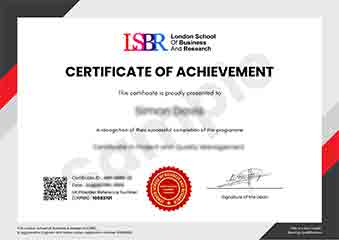
Sample Certificate
Preview the certificate you'll receive upon successful completion of this program.
Get Course Info
Receive the full course guide, pricing details, and enrolment instructions directly in your inbox.
Check your inbox!
Course details have been sent to your email.
Get Your Employer to Sponsor This Programme
Many employers offer professional development budgets. We make it easy for your company to invest in your growth with corporate invoicing and bulk enrolment options.
Email Template for Your Manager
Dear [Manager's Name],
I would like to request sponsorship for the Executive Development Programme in Geometric Analysis for Environmental Modeling programme offered by LSBR London - Executive Education.
The programme costs $199 (one-time) and can be completed in 3-4 weeks alongside my regular duties.
Key benefits to our team:
- Immediately applicable skills
- Globally recognised certificate
- Corporate invoice available
Best regards,
[Your Name]
What Our Students Say
Hear from our students about their experience with the Executive Development Programme in Geometric Analysis for Environmental Modeling at LSBR London - Executive Education.
Charlotte Williams
United Kingdom"The modules on differential geometry and stochastic modeling were exceptionally clear and directly applicable to real-world environmental data sets. I left the programme confident in using advanced curvature analysis and numerical simulation tools, which have already opened up new project opportunities in climate impact assessment."
Connor O'Brien
Canada"The program equipped me with cutting‑edge geometric analysis tools that I could immediately apply to complex environmental models, dramatically improving the accuracy of our climate impact assessments. Since completing the course, I’ve been promoted to lead the sustainability analytics team, and our department now secures high‑value contracts thanks to the advanced modeling capabilities I bring."
Isabella Dubois
Canada"The programme’s modular layout made it easy to progress from foundational geometry to advanced environmental modeling techniques, and each segment built logically on the last. The comprehensive content, packed with real‑world case studies, gave me a clear toolkit for tackling complex spatial problems and has already boosted my confidence in applying geometric analysis to sustainability projects."
Your Certification Journey
Four simple steps from enrolment to your globally recognised certificate
Enrol Online
Complete your enrolment in under 2 minutes with secure checkout
Start Learning
Get instant access to all course materials and start at your own pace
Complete Modules
Work through the curriculum with expert support available throughout
Get Certified
Receive your LSBR London certificate recognised across 180+ countries
LSBR London by the Numbers
Join a global community of professionals advancing their careers
Students Enrolled
Countries Represented
Average Rating
Career Progression