
Global Certificate in Practical Deep Learning Architectures for Image Recognition
This certificate equips professionals with hands-on skills in designing and implementing deep learning models for image recognition, enhancing career prospects in AI and machine learning.
Global Certificate in Practical Deep Learning Architectures for Image Recognition
Programme Overview
This course is for professionals, students, and anyone eager to dive into deep learning for image recognition. You'll gain hands-on experience with practical deep learning architectures. First, you'll learn to build and train convolutional neural networks (CNNs). Next, you'll explore advanced topics like transfer learning and generative models.
Moreover, you'll work on real-world projects, applying what you've learned. Additionally, you'll learn to use popular frameworks like TensorFlow and PyTorch. Finally, you'll receive a globally recognized certificate upon completion, enhancing your resume and career prospects.
What You'll Learn
Dive into the future of image recognition with our Global Certificate in Practical Deep Learning Architectures for Image Recognition. First, you'll master the basics of deep learning. Next, you'll explore cutting-edge architectures like CNNs, GANs, and Transformers. Then, you'll apply these models to real-world problems in healthcare, autonomous driving, and entertainment. Moreover, you'll gain hands-on experience with industry-standard tools and frameworks.
Benefit from our expert-led, interactive sessions. Furthermore, connect with a global community of learners. Meanwhile, work on projects that showcase your skills to future employers. Lastly, unlock career opportunities in AI, data science, and machine learning.
Stand out in a competitive job market. Enroll now and transform your career in deep learning!
Programme Highlights
Industry-Aligned Curriculum
Developed with industry leaders to ensure practical, job-ready skills valued by employers worldwide.
Expert Faculty
Learn from experienced professionals with real-world expertise in your chosen field.
Flexible Learning
Study at your own pace, from anywhere in the world, with our flexible online platform.
Industry Focus
Practical, real-world knowledge designed to meet the demands of today's competitive job market.
Latest Curriculum
Stay ahead with constantly updated content reflecting the latest industry trends and best practices.
Career Advancement
Unlock new opportunities with a globally recognized qualification respected by employers.
Topics Covered
- Introduction to Deep Learning: Understand the fundamentals and history of deep learning.
- Convolutional Neural Networks (CNNs): Explore the architecture and applications of CNNs in image recognition.
- Transfer Learning and Pre-trained Models: Learn to leverage pre-trained models for efficient image recognition tasks.
- Advanced CNN Architectures: Study state-of-the-art CNN models like ResNet, Inception, and EfficientNet.
- Generative Models for Image Recognition: Delve into GANs and autoencoders for image generation and recognition.
- Practical Implementation and Optimization: Gain hands-on experience in deploying and optimizing deep learning models.
Key Facts
Audience:
Professionals seeking to enhance deep learning skills.
Data scientists, engineers, and developers aiming to specialize in image recognition.
Those interested in transitioning to roles in machine learning.
Prerequisites:
Basic understanding of Python programming.
Familiarity with fundamental machine learning concepts.
No prior deep learning experience required to begin.
Outcomes:
First, you will learn to design and implement deep learning models.
Next, you will gain hands-on experience with popular frameworks like TensorFlow and PyTorch.
Finally, you will be able to deploy and optimize image recognition models for real-world applications.
Why This Course
First, this certificate equips learners with hands-on skills. You will dive into real-world projects. This makes learning practical and engaging.
Next, the curriculum covers a wide range of topics. You will explore various image recognition techniques. Moreover, you will learn how to implement them using popular frameworks. This ensures a well-rounded understanding.
Finally, earning this certificate boosts your career prospects. It shows employers you have the skills. Plus, you can showcase your projects to demonstrate your abilities. As a result, you stand out in the job market.
Programme Title
Global Certificate in Practical Deep Learning Architectures for Image Recognition
Course Brochure
Download our comprehensive course brochure with all details
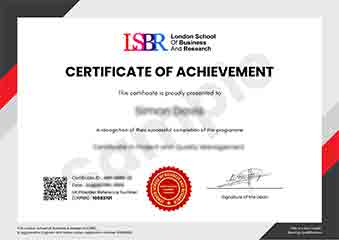
Sample Certificate
Preview the certificate you'll receive upon successful completion of this program.
Pay as an Employer
Request an invoice for your company to pay for this course. Perfect for corporate training and professional development.
What People Say About Us
Hear from our students about their experience with the Global Certificate in Practical Deep Learning Architectures for Image Recognition at LSBR London - Executive Education.
James Thompson
United Kingdom"The course content was incredibly comprehensive, covering a wide range of deep learning architectures with a strong focus on image recognition. I gained practical skills that I could immediately apply to real-world projects, which has significantly boosted my confidence and employability in the field of machine learning."
Oliver Davies
United Kingdom"This course has been a game-changer for my career in computer vision. The practical deep learning architectures I learned are directly applicable to real-world image recognition tasks, making me more competitive in the job market. I've already seen a significant impact on my projects, and I'm confident that the skills I've gained will open up new opportunities for advancement."
Brandon Wilson
United States"The course structure was exceptionally well-organized, with each module building logically on the previous one, making complex topics in deep learning for image recognition accessible and easy to follow. The comprehensive content not only covered theoretical foundations but also delved into real-world applications, significantly enhancing my professional growth and confidence in applying these architectures in practical scenarios."