
Postgraduate Certificate in Mathematical Modeling for Simulation
Master advanced simulation techniques to solve complex problems, driving data-informed decisions and enhancing professional expertise in mathematical modeling.
Postgraduate Certificate in Mathematical Modeling for Simulation
Programme Summary
The Postgraduate Certificate in Mathematical Modeling for Simulation targets experienced professionals and advanced undergraduates seeking to bridge theoretical mathematics with computational application. This rigorous curriculum examines differential equations, stochastic processes, and numerical analysis within the context of complex system behaviour. Participants engage with industry-standard software environments to construct robust simulations that replicate real-world phenomena accurately. The programme demands a strong foundation in calculus and linear algebra, ensuring that all students possess the necessary technical prerequisites for advanced study.
Learners acquire proficiency in translating abstract mathematical concepts into executable code using Python, MATLAB, or C++. Students master techniques for validating models against empirical data to ensure predictive reliability and statistical significance. The course emphasises sensitivity analysis and uncertainty quantification, enabling participants to assess risk factors within dynamic systems effectively. Graduates develop the ability to optimise simulation parameters for computational efficiency without sacrificing model fidelity or accuracy. These competencies prepare individuals to handle large-scale datasets and intricate algorithmic structures confidently.
Completion of this certificate significantly enhances employability in sectors reliant on quantitative decision-making, including finance, engineering, and logistics. Employers value graduates who can reduce operational risks through precise predictive modeling and scenario planning. Alumni frequently secure roles as quantitative analysts, simulation engineers, or data scientists within leading multinational corporations. The credential demonstrates a specialised expertise that distinguishes candidates in competitive job markets demanding high-level analytical rigour. Professionals leverage these advanced skills to drive strategic innovation and operational excellence within their respective organisations.
Learning Outcomes
This rigorous Postgraduate Certificate equips professionals with the analytical rigour required to translate complex real-world phenomena into precise computational frameworks. In an era defined by data saturation, the ability to construct robust mathematical models is no longer optional; it is a critical competency for strategic decision-making across industries. The curriculum bridges the gap between abstract theory and practical application, ensuring participants can derive actionable insights from intricate datasets with confidence and precision.
Students engage deeply with stochastic processes, differential equations, and numerical analysis, mastering the algorithms that underpin modern simulation software. The programme places significant emphasis on computational proficiency, requiring learners to implement models using industry-standard programming languages such as Python and C++. Case studies drawn from finance, engineering, and logistics illustrate how theoretical constructs solve tangible operational challenges. Participants learn to validate their models against empirical data, ensuring reliability and reducing the risk of costly errors in high-stakes environments.
Graduates emerge with the capacity to design sophisticated simulations that predict system behaviour under varying conditions. This expertise allows them to optimise supply chains, assess financial risks, and enhance product design cycles. Employers value these skills for their direct impact on efficiency and innovation. Career pathways extend into roles such as Quantitative Analyst, Simulation Engineer, and Data Scientist within leading financial institutions, technology firms, and consultancies. The certificate also serves as a powerful differentiator for those seeking promotion into senior analytical positions. By mastering the art of mathematical modelling, professionals position themselves at the forefront of technological advancement, driving evidence-based strategies that
Programme Features
Industry-Aligned Curriculum
Developed with industry leaders for job-ready skills
Globally Recognised Certificate
Recognised by employers across 180+ countries
Flexible Online Learning
Study at your own pace with lifetime access
Instant Access
Start learning immediately, no application process
Constantly Updated Content
Latest industry trends and best practices
Career Advancement
87% report measurable career progression within 6 months
Course Modules
- Mathematical Foundations for Simulation: Reviews essential calculus, linear algebra, and differential equations required for modeling dynamic systems.: Stochastic Processes and Probability: Examines random variables, Markov chains, and queueing theory to model uncertainty in complex environments.
- Numerical Methods and Algorithms: Focuses on computational techniques for solving mathematical equations that lack analytical solutions.: Discrete-Event Simulation: Teaches the design and implementation of simulations for systems where state changes occur at distinct points in time.
- Agent-Based Modeling: Explores the simulation of autonomous agents interacting within an environment to study emergent macro-level behaviors.: Statistical Analysis and Validation: Covers methods for calibrating models, analyzing output data, and verifying simulation accuracy against real-world observations.
What's Included in This Programme
Here is what you get when you enrol with LSBR London
Programme Facts
Audience: Professionals seeking advanced quantitative simulation skills.
Prerequisites: Undergraduate mathematics degree or equivalent competence.
Outcomes: Mastery of computational modelling techniques and analysis.
Ready to advance your career?
Join thousands of professionals who have transformed their careers with LSBR London. Enrol today and start learning immediately.
Why Study This Programme
Pursuing a Postgraduate Certificate in Mathematical Modeling for Simulation represents a strategic investment in high-value analytical capabilities. This qualification equips professionals with the rigorous theoretical foundation necessary to translate complex real-world phenomena into computable frameworks, a skill increasingly demanded across finance, engineering, and data science sectors.
Enhanced Predictive Accuracy: Candidates master stochastic differential equations and Monte Carlo methods, enabling them to construct robust simulations that quantify uncertainty. This capability directly improves risk assessment protocols within financial institutions, allowing for more precise hedging strategies and capital allocation decisions.
Operational Efficiency Optimisation: The curriculum emphasises discrete-event simulation techniques applicable to supply chain logistics and manufacturing processes. Graduates learn to identify bottlenecks and simulate process changes before implementation, thereby reducing operational costs and enhancing throughput without disrupting live systems.
Advanced Computational Proficiency: Participants gain hands-on experience with industry-standard software such as MATLAB, Python, and Simulink. This technical fluency ensures immediate productivity upon return to the workplace, facilitating seamless integration of new modeling tools into existing data infrastructure and accelerating project delivery timelines.
Strategic Decision-Making Authority: By bridging the gap between abstract mathematics and practical application, this certificate empowers professionals to advise senior leadership with data-driven insights. This elevated competence fosters trust in analytical recommendations, positioning graduates for leadership roles in quantitative analysis and strategic planning departments.
"This programme gave me the confidence and credentials to secure a senior role. Highly recommend LSBR London."
— Sarah M., United Kingdom
Course Brochure
Download our comprehensive course brochure with all details
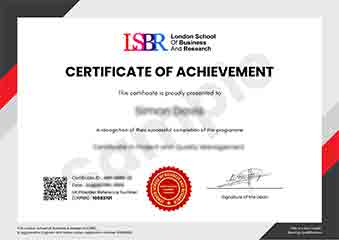
Sample Certificate
Preview the certificate you'll receive upon successful completion of this program.
Get Course Info
Receive the full course guide, pricing details, and enrolment instructions directly in your inbox.
Check your inbox!
Course details have been sent to your email.
Get Your Employer to Sponsor This Programme
Many employers offer professional development budgets. We make it easy for your company to invest in your growth with corporate invoicing and bulk enrolment options.
Email Template for Your Manager
Dear [Manager's Name],
I would like to request sponsorship for the Postgraduate Certificate in Mathematical Modeling for Simulation programme offered by LSBR London - Executive Education.
The programme costs $149 (one-time) and can be completed in 3-4 weeks alongside my regular duties.
Key benefits to our team:
- Immediately applicable skills
- Globally recognised certificate
- Corporate invoice available
Best regards,
[Your Name]
What Our Students Say
Hear from our students about their experience with the Postgraduate Certificate in Mathematical Modeling for Simulation at LSBR London - Executive Education.
Oliver Davies
United Kingdom"The curriculum strikes an excellent balance between theoretical rigor and real-world application, particularly in the modules covering stochastic processes and numerical methods. I now feel confident in building complex simulation models that accurately reflect dynamic systems, a skill that has immediately enhanced my analytical capabilities in my current role."
Kavya Reddy
India"Mastering the simulation techniques in this program allowed me to immediately optimize complex supply chain logistics at my new role. The practical focus on mathematical modeling bridging theory and real-world data gave me a distinct competitive edge during my promotion interview."
Jack Thompson
Australia"The logical progression of the curriculum seamlessly bridges theoretical foundations with practical simulation techniques, making complex concepts accessible. This comprehensive approach has significantly enhanced my ability to apply mathematical modeling to real-world engineering challenges, directly boosting my professional confidence."
Your Certification Journey
Four simple steps from enrolment to your globally recognised certificate
Enrol Online
Complete your enrolment in under 2 minutes with secure checkout
Start Learning
Get instant access to all course materials and start at your own pace
Complete Modules
Work through the curriculum with expert support available throughout
Get Certified
Receive your LSBR London certificate recognised across 180+ countries
LSBR London by the Numbers
Join a global community of professionals advancing their careers
Students Enrolled
Countries Represented
Average Rating
Career Progression