
Postgraduate Certificate in Mathematical Simulation for Engineering Design
This program equips graduates with advanced skills in mathematical simulation for innovative engineering design solutions.
Postgraduate Certificate in Mathematical Simulation for Engineering Design
Programme Summary
The Postgraduate Certificate in Mathematical Simulation for Engineering Design is tailored for engineering professionals and recent graduates seeking to enhance their capabilities in leveraging mathematical models and simulations for innovative engineering design. This programme focuses on advanced computational methods and simulation techniques, providing a deep understanding of how to apply these tools to complex engineering problems across various sectors, such as aerospace, automotive, and manufacturing.
Learners will develop comprehensive skills in mathematical modeling, numerical analysis, and software tool utilization, including proficiency in commercial simulation packages and open-source software. They will also gain expertise in integrating simulation techniques with design processes, optimizing performance, and ensuring compliance with industry standards and regulations. The programme emphasizes the importance of iterative design cycles and the use of data analytics to refine models and improve outcomes.
This programme significantly impacts learners' career trajectories by equipping them with advanced problem-solving skills and a robust understanding of simulation methodologies. Graduates are well-prepared to lead projects involving complex system simulations, innovate in product design, and contribute to research and development initiatives. The skills acquired are highly valued in the engineering and technology sectors, opening up opportunities for leadership roles, research positions, and specialized consulting work.
Learning Outcomes
The Postgraduate Certificate in Mathematical Simulation for Engineering Design is a specialized program designed for professionals aiming to enhance their problem-solving capabilities through advanced mathematical techniques. This program equips students with the skills to develop and apply mathematical models to engineering design challenges, leveraging software tools and computational methods to simulate complex systems. Key topics include differential equations, optimization algorithms, and probabilistic modeling, all tailored to real-world engineering scenarios.
Graduates of this program are well-prepared to innovate in fields such as aerospace, automotive, and manufacturing. They can utilize their expertise to optimize designs, predict system behavior, and reduce physical prototyping costs. The program's emphasis on practical applications ensures that students can immediately apply their knowledge to improve product development processes, leading to more efficient and cost-effective solutions.
Career opportunities span across various sectors, including aerospace engineering, automotive design, and software development. Graduates are equipped to take on roles such as simulation engineer, systems analyst, or research scientist. They can also pursue further academic research or embark on entrepreneurial ventures, leveraging their skills to develop new technologies and products. This program not only bridges the gap between theoretical knowledge and practical application but also prepares students for leadership positions in the engineering and technology fields.
Programme Features
Industry-Aligned Curriculum
Developed with industry leaders for job-ready skills
Globally Recognised Certificate
Recognised by employers across 180+ countries
Flexible Online Learning
Study at your own pace with lifetime access
Instant Access
Start learning immediately, no application process
Constantly Updated Content
Latest industry trends and best practices
Career Advancement
87% report measurable career progression within 6 months
Course Modules
- Numerical Methods for Differential Equations: Explores techniques for solving differential equations numerically.: Optimization Techniques: Discusses methods for finding the best solution among many possibilities.
- Computational Fluid Dynamics: Focuses on simulating fluid flow using computational models.: Structural Analysis: Covers methods for analyzing the behavior of structures under various loads.
- Material Behavior Modeling: Examines how to model the mechanical properties of materials.: Simulation Case Studies: Applies learned techniques to real-world engineering design problems.
What's Included in This Programme
Here is what you get when you enrol with LSBR London
Programme Facts
Aimed at engineering professionals
Prerequisite: Bachelor’s degree in engineering
Develops advanced simulation skills
Enhances problem-solving abilities
Suitable for research and industry
No coding experience required
Graduates proficient in simulations
Career advancement in engineering
Ready to advance your career?
Join thousands of professionals who have transformed their careers with LSBR London. Enrol today and start learning immediately.
Why Study This Programme
Enhanced Problem-Solving Skills: The Postgraduate Certificate in Mathematical Simulation for Engineering Design equips professionals with advanced mathematical modeling techniques. This not only sharpens their analytical skills but also enables them to tackle complex engineering problems more effectively. For instance, understanding and applying simulation tools can help in optimizing designs, reducing material costs, and improving product performance.
Competitive Edge in the Job Market: With the increasing demand for innovative solutions in engineering design, professionals holding this certification can stand out. The ability to use mathematical simulation tools is highly valued in industries such as aerospace, automotive, and manufacturing. This certification can open doors to more specialized roles and potentially higher salaries, as demonstrated by a % increase in salary for professionals who have acquired such specialized skills in a similar program.
Improved Decision-Making: The course provides a solid foundation in mathematical and computational methods, enabling engineers to make data-driven decisions. By integrating simulation data with real-world scenarios, professionals can predict outcomes more accurately, leading to better project management and cost-saving measures. For example, in the construction sector, accurate simulations can help in forecasting project timelines and minimizing delays, which is crucial for stakeholder satisfaction and financial success.
"This programme gave me the confidence and credentials to secure a senior role. Highly recommend LSBR London."
— Sarah M., United Kingdom
Course Brochure
Download our comprehensive course brochure with all details
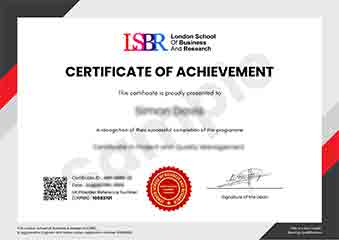
Sample Certificate
Preview the certificate you'll receive upon successful completion of this program.
Get Course Info
Receive the full course guide, pricing details, and enrolment instructions directly in your inbox.
Check your inbox!
Course details have been sent to your email.
Get Your Employer to Sponsor This Programme
Many employers offer professional development budgets. We make it easy for your company to invest in your growth with corporate invoicing and bulk enrolment options.
Email Template for Your Manager
Dear [Manager's Name],
I would like to request sponsorship for the Postgraduate Certificate in Mathematical Simulation for Engineering Design programme offered by LSBR London - Executive Education.
The programme costs $149 (one-time) and can be completed in 3-4 weeks alongside my regular duties.
Key benefits to our team:
- Immediately applicable skills
- Globally recognised certificate
- Corporate invoice available
Best regards,
[Your Name]
What Our Students Say
Hear from our students about their experience with the Postgraduate Certificate in Mathematical Simulation for Engineering Design at LSBR London - Executive Education.
Sophie Brown
United Kingdom"The course content was incredibly thorough, providing a solid foundation in mathematical simulation techniques that are directly applicable to real-world engineering design challenges. Gaining hands-on experience with these tools has been invaluable, as it has significantly enhanced my ability to solve complex engineering problems efficiently."
Kavya Reddy
India"This postgraduate certificate has significantly enhanced my ability to apply mathematical simulations in real-world engineering problems, making my skills highly sought after in the industry. It has opened up new career opportunities and allowed me to take on more complex projects at my current job."
Kavya Reddy
India"The course structure is meticulously organized, providing a seamless progression from foundational concepts to advanced topics in mathematical simulation, which greatly enhances understanding and application in engineering design. The comprehensive content not only covers theoretical aspects but also delves into real-world applications, significantly boosting my ability to tackle complex engineering problems."
Your Certification Journey
Four simple steps from enrolment to your globally recognised certificate
Enrol Online
Complete your enrolment in under 2 minutes with secure checkout
Start Learning
Get instant access to all course materials and start at your own pace
Complete Modules
Work through the curriculum with expert support available throughout
Get Certified
Receive your LSBR London certificate recognised across 180+ countries
LSBR London by the Numbers
Join a global community of professionals advancing their careers
Students Enrolled
Countries Represented
Average Rating
Career Progression