
Postgraduate Certificate in Space Mission Design and Mathematical Modeling
Master space mission design and mathematical modeling to advance your career in the aerospace industry.
Postgraduate Certificate in Space Mission Design and Mathematical Modeling
Programme Summary
This rigorous postgraduate certificate equips aspiring aerospace engineers and senior analysts with advanced competencies in orbital mechanics and systems engineering. The curriculum targets professionals seeking to bridge theoretical physics with practical mission architecture, focusing on low Earth orbit operations and interplanetary trajectory optimisation. Participants engage with complex mathematical frameworks to design sustainable satellite constellations and deep-space probes. The programme demands a strong foundation in calculus and linear algebra, ensuring that graduates can immediately contribute to high-stakes defence and commercial space sectors.
Learners master the derivation of equations of motion, perturbation analysis, and numerical integration techniques essential for precise trajectory prediction. Students develop proficiency in using industry-standard simulation software to model attitude control systems and propulsion dynamics under varying environmental constraints. The course emphasises robust error analysis and uncertainty quantification, enabling participants to mitigate risks associated with orbital debris and atmospheric drag. Graduates acquire the ability to translate abstract mathematical models into actionable engineering specifications for launch vehicles and payload deployments.
Completion of this certificate significantly enhances employability within the rapidly expanding global space economy. Alumni secure senior technical roles at leading aerospace contractors, government agencies, and emerging NewSpace startups. The qualification demonstrates a verified capacity to handle complex mission planning challenges, distinguishing candidates in competitive job markets. Employers value the programme’s focus on delivering immediate, applicable solutions to real-world engineering problems. This credential positions graduates for leadership positions in mission design teams, driving innovation in satellite communications and planetary exploration initiatives.
Learning Outcomes
The Postgraduate Certificate in Space Mission Design and Mathematical Modelling represents a rigorous academic endeavour designed for professionals seeking to master the intricate mechanics of orbital dynamics and systems engineering. This programme distinguishes itself through its unwavering focus on the intersection of theoretical physics and practical application, ensuring that students acquire the analytical rigour necessary to navigate the complexities of modern aerospace challenges. Participants engage deeply with advanced computational methods, trajectory optimisation, and the precise mathematical frameworks that underpin successful mission architecture.
Curriculum modules explore critical areas such as orbital mechanics, spacecraft attitude control, and the integration of multi-disciplinary design constraints. Students learn to construct robust simulation models that predict system behaviour under varying environmental conditions, thereby minimising risk and enhancing mission reliability. The pedagogical approach emphasises hands-on problem solving, requiring learners to apply sophisticated algorithms to real-world scenarios encountered by leading aerospace organisations.
Graduates emerge with the capability to design efficient mission profiles and evaluate complex engineering trade-offs with confidence. These skills are immediately applicable in roles within satellite operations, launch vehicle development, and space exploration agencies. Employers value the programme’s alumni for their ability to translate abstract mathematical concepts into tangible engineering solutions, a competency increasingly vital in the rapidly evolving commercial space sector.
Career pathways extend across government bodies like the UK Space Agency, international entities such as the European Space Agency, and private enterprise leaders including Airbus and Rocket Lab. Professionals often secure positions in mission planning, systems analysis, and advanced research, contributing to the next generation of
Programme Features
Industry-Aligned Curriculum
Developed with industry leaders for job-ready skills
Globally Recognised Certificate
Recognised by employers across 180+ countries
Flexible Online Learning
Study at your own pace with lifetime access
Instant Access
Start learning immediately, no application process
Constantly Updated Content
Latest industry trends and best practices
Career Advancement
87% report measurable career progression within 6 months
Course Modules
- Orbital Mechanics and Astrodynamics: Analyzes Keplerian motion, perturbations, and trajectory design for satellite operations.: Spacecraft Systems Engineering: Examines the integration of subsystems including power, propulsion, and thermal control.
- Advanced Mathematical Modeling: Develops differential equations and numerical methods for simulating complex space environments.: Mission Analysis and Trade Studies: Evaluates mission constraints, payload requirements, and operational scenarios using optimization techniques.
- Guidance, Navigation, and Control: Covers sensor fusion, attitude determination, and control algorithms for spacecraft stability.: Space Environment and Radiation Effects: Investigates atmospheric drag, radiation belts, and their impact on mission longevity and design.
What's Included in This Programme
Here is what you get when you enrol with LSBR London
Programme Facts
Audience: Early-career engineers and quantitative analysts seeking aerospace specialisation.
Prerequisites: Undergraduate degree in mathematics, physics, or engineering disciplines.
Outcomes: Mastery of orbital mechanics and advanced simulation techniques.
Ready to advance your career?
Join thousands of professionals who have transformed their careers with LSBR London. Enrol today and start learning immediately.
Why Study This Programme
Pursuing the Postgraduate Certificate in Space Mission Design and Mathematical Modeling offers a strategic advantage for professionals seeking to capitalise on the burgeoning commercial space sector. This qualification bridges the critical gap between theoretical astrophysics and practical engineering constraints, ensuring graduates possess the precise technical acumen required for high-stakes mission planning.
Mastery of advanced orbital mechanics and trajectory optimisation equips candidates to design cost-effective launch windows and efficient satellite constellations. This expertise directly translates into reduced operational expenditures for aerospace firms, making such professionals invaluable to mission architecture teams.
The rigorous focus on mathematical modelling enhances one’s ability to simulate complex system interactions under uncertainty. Graduates learn to predict failure modes and optimise payload performance, thereby increasing mission reliability and safeguarding significant financial investments in hardware and insurance.
Exposure to interdisciplinary project management frameworks fosters the capability to lead diverse engineering teams. This skill set is essential for coordinating between propulsion, communications, and software divisions, ensuring seamless integration of subsystems within tight developmental schedules.
The certificate serves as a distinctive credential in a competitive labour market, signalling specialised competence to employers in both governmental agencies and private enterprises. This distinction often accelerates career progression into senior technical roles or project leadership positions.
By acquiring these targeted competencies, professionals position themselves at the forefront of the new space economy. The programme delivers tangible value through immediate applicability of skills, ensuring graduates can contribute meaningfully from day one. Such focused education remains a prudent
"This programme gave me the confidence and credentials to secure a senior role. Highly recommend LSBR London."
— Sarah M., United Kingdom
Course Brochure
Download our comprehensive course brochure with all details
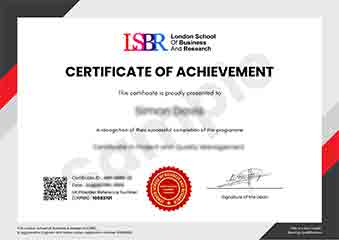
Sample Certificate
Preview the certificate you'll receive upon successful completion of this program.
Get Course Info
Receive the full course guide, pricing details, and enrolment instructions directly in your inbox.
Check your inbox!
Course details have been sent to your email.
Get Your Employer to Sponsor This Programme
Many employers offer professional development budgets. We make it easy for your company to invest in your growth with corporate invoicing and bulk enrolment options.
Email Template for Your Manager
Dear [Manager's Name],
I would like to request sponsorship for the Postgraduate Certificate in Space Mission Design and Mathematical Modeling programme offered by LSBR London - Executive Education.
The programme costs $149 (one-time) and can be completed in 3-4 weeks alongside my regular duties.
Key benefits to our team:
- Immediately applicable skills
- Globally recognised certificate
- Corporate invoice available
Best regards,
[Your Name]
What Our Students Say
Hear from our students about their experience with the Postgraduate Certificate in Space Mission Design and Mathematical Modeling at LSBR London - Executive Education.
Charlotte Williams
United Kingdom"The rigorous focus on orbital mechanics and trajectory optimization provided a robust theoretical foundation that immediately translated into tangible design capabilities. Mastering these mathematical modeling techniques has significantly boosted my confidence in tackling complex mission architecture challenges in the aerospace industry."
Arjun Patel
India"Mastering the mathematical modeling techniques in this program gave me the confidence to tackle complex orbital mechanics challenges in my current role. The curriculum’s direct alignment with industry standards accelerated my transition into a senior mission design position, proving that theoretical rigor translates directly to practical engineering success."
Brandon Wilson
United States"The logical progression from theoretical mathematical modeling to practical space mission design provided a robust framework for understanding complex orbital mechanics. This structured approach significantly enhanced my ability to apply abstract concepts to real-world engineering challenges, directly accelerating my professional readiness in the aerospace sector."
Your Certification Journey
Four simple steps from enrolment to your globally recognised certificate
Enrol Online
Complete your enrolment in under 2 minutes with secure checkout
Start Learning
Get instant access to all course materials and start at your own pace
Complete Modules
Work through the curriculum with expert support available throughout
Get Certified
Receive your LSBR London certificate recognised across 180+ countries
LSBR London by the Numbers
Join a global community of professionals advancing their careers
Students Enrolled
Countries Represented
Average Rating
Career Progression