
Professional Certificate in Applied Geometry in Computer Science
Master geometric algorithms to optimize algorithms, enhancing computational efficiency and problem-solving skills for advanced computer science applications.
Professional Certificate in Applied Geometry in Computer Science
Programme Summary
This rigorous Professional Certificate equips software engineers and data scientists with the mathematical foundations necessary to solve complex spatial problems within modern computing environments. The curriculum targets experienced professionals seeking to integrate advanced geometric algorithms into their existing technical workflows, ensuring immediate applicability to real-world challenges. Participants engage with core topics including computational geometry, spatial indexing, and D modelling techniques, all delivered through a blend of theoretical instruction and practical coding exercises. The programme demands a strong background in programming and linear algebra, positioning it as an advanced qualification for those ready to deepen their technical expertise.
Learners acquire proficiency in implementing efficient algorithms for collision detection, pathfinding, and mesh processing, which are critical components of high-performance applications. The course emphasises the translation of abstract geometric principles into robust, optimised code using industry-standard languages such as C++ and Python. Students develop the ability to analyse spatial data structures, enabling them to handle large-scale datasets with precision and speed. This hands-on approach ensures that graduates can immediately apply their new knowledge to enhance the performance and reliability of software systems dealing with spatial information.
Completion of this certificate significantly enhances employability in sectors reliant on precise spatial computation, including gaming, robotics, and geographic information systems. Professionals gain a competitive edge by demonstrating mastery over niche mathematical domains that are increasingly vital in artificial intelligence and computer vision. Employers value the ability to optimise geometric calculations, leading to roles in senior engineering positions and specialised technical leadership. This qualification serves as a definitive marker of expertise,
Learning Outcomes
This Professional Certificate equips technology leaders and senior developers with the rigorous mathematical frameworks essential for advancing computer science applications. By bridging the gap between abstract geometric theory and practical computational implementation, the course empowers professionals to solve complex spatial problems with precision and efficiency. Participants gain a competitive edge by mastering tools that drive innovation in graphics, robotics, and data visualisation, ensuring their organisations remain at the forefront of technological development.
The curriculum explores critical areas such as computational geometry, linear algebra, and topological data analysis. Students engage with algorithms for convex hulls, Voronoi diagrams, and mesh processing, while also examining the geometric underpinnings of machine learning models. Practical sessions utilise industry-standard software to simulate real-world scenarios, allowing learners to test theoretical concepts against tangible challenges. This hands-on approach ensures that participants not only understand the mathematics but also know how to deploy it effectively within modern software architectures.
Graduates emerge capable of optimising rendering pipelines in gaming engines, enhancing navigation systems in autonomous vehicles, and improving spatial indexing in large-scale databases. These skills are directly transferable to roles requiring high-level analytical thinking and technical expertise. Career opportunities abound in sectors ranging from artificial intelligence and virtual reality to urban planning and biomedical imaging. Professionals may pursue positions as senior algorithm engineers, research scientists, or technical consultants, driving strategic decisions that rely on accurate spatial reasoning.
The programme fosters a network of peers and mentors who share a commitment to excellence in applied mathematics. Participants leave with a robust
Programme Features
Industry-Aligned Curriculum
Developed with industry leaders for job-ready skills
Globally Recognised Certificate
Recognised by employers across 180+ countries
Flexible Online Learning
Study at your own pace with lifetime access
Instant Access
Start learning immediately, no application process
Constantly Updated Content
Latest industry trends and best practices
Career Advancement
87% report measurable career progression within 6 months
Course Modules
- Computational Geometry Basics: Introduces fundamental geometric structures and algorithms for efficient spatial data processing.: Geometric Data Structures: Covers essential structures like kd-trees and quad-trees for organizing and querying geometric data.
- Convex Hulls and Decomposition: Explores algorithms for computing convex hulls and partitioning complex shapes into simpler components.: Computational Meshing: Focuses on generating triangular and polygonal meshes for simulation and computer graphics applications.
- Geometric Transformations and Intersections: Examines techniques for calculating intersections, unions, and transformations of geometric objects.: Applications in Computer Graphics: Applies geometric principles to rendering, modeling, and animation in modern computer graphics pipelines.
What's Included in This Programme
Here is what you get when you enrol with LSBR London
Programme Facts
Audience: Software engineers and data scientists seeking geometric proficiency.
Prerequisites: Fundamental programming skills and basic linear algebra knowledge.
Outcomes: Mastery of spatial algorithms for computational applications.
Ready to advance your career?
Join thousands of professionals who have transformed their careers with LSBR London. Enrol today and start learning immediately.
Why Study This Programme
The Professional Certificate in Applied Geometry in Computer Science offers a strategic advantage for tech professionals seeking to enhance their technical repertoire. This programme bridges the gap between theoretical mathematical foundations and practical software engineering, delivering tangible career benefits.
Enhanced Employability in Specialised Sectors: Graduates gain immediate access to high-demand roles in computer graphics, robotics, and virtual reality. Employers increasingly value candidates who possess robust geometric intuition, allowing them to optimise rendering pipelines and spatial algorithms effectively. This specialisation distinguishes applicants in a saturated market, leading to superior salary prospects and accelerated promotion trajectories within leading technology firms.
Mastery of Critical Computational Techniques: The curriculum provides deep proficiency in computational geometry algorithms, including mesh processing and collision detection. Participants develop the ability to implement efficient solutions for complex spatial problems, directly improving software performance and reliability. Such technical expertise is indispensable for developers working on augmented reality applications or autonomous navigation systems, where precision and speed are paramount.
Improved Problem-Solving Frameworks: Engaging with rigorous geometric principles cultivates a structured approach to algorithmic design. Professionals learn to decompose intricate spatial challenges into manageable components, fostering clearer logic and more maintainable codebases. This methodological shift enhances overall software quality and reduces debugging time, contributing significantly to project success.
Future-Proofing Against Technological Shifts: As industries pivot towards digital twins and immersive technologies, geometric literacy becomes essential. This certificate ensures practitioners
"This programme gave me the confidence and credentials to secure a senior role. Highly recommend LSBR London."
— Sarah M., United Kingdom
Course Brochure
Download our comprehensive course brochure with all details
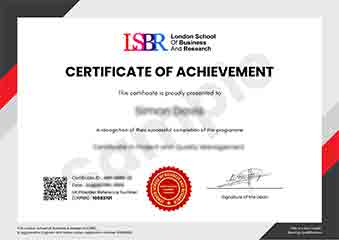
Sample Certificate
Preview the certificate you'll receive upon successful completion of this program.
Get Course Info
Receive the full course guide, pricing details, and enrolment instructions directly in your inbox.
Check your inbox!
Course details have been sent to your email.
Get Your Employer to Sponsor This Programme
Many employers offer professional development budgets. We make it easy for your company to invest in your growth with corporate invoicing and bulk enrolment options.
Email Template for Your Manager
Dear [Manager's Name],
I would like to request sponsorship for the Professional Certificate in Applied Geometry in Computer Science programme offered by LSBR London - Executive Education.
The programme costs $149 (one-time) and can be completed in 3-4 weeks alongside my regular duties.
Key benefits to our team:
- Immediately applicable skills
- Globally recognised certificate
- Corporate invoice available
Best regards,
[Your Name]
What Our Students Say
Hear from our students about their experience with the Professional Certificate in Applied Geometry in Computer Science at LSBR London - Executive Education.
Sophie Brown
United Kingdom"The curriculum effectively bridges theoretical geometry with real-world computer science applications, particularly in 3D modeling and spatial algorithms. I gained immediate, practical skills in implementing geometric transformations that have significantly enhanced my ability to solve complex programming challenges."
Tyler Johnson
United States"Mastering the geometric algorithms in this program directly bridged the gap between my theoretical knowledge and the complex spatial computing challenges I face daily in game engine development. This practical expertise not only streamlined my workflow but also positioned me for a senior role where optimizing 3D rendering pipelines is critical."
Jia Li Lim
Singapore"The logical progression from foundational geometric principles to complex computational implementations provided a robust framework for understanding spatial algorithms. This structured approach significantly enhanced my ability to apply mathematical concepts directly to software development challenges, bridging the gap between theory and practical engineering."
Your Certification Journey
Four simple steps from enrolment to your globally recognised certificate
Enrol Online
Complete your enrolment in under 2 minutes with secure checkout
Start Learning
Get instant access to all course materials and start at your own pace
Complete Modules
Work through the curriculum with expert support available throughout
Get Certified
Receive your LSBR London certificate recognised across 180+ countries
LSBR London by the Numbers
Join a global community of professionals advancing their careers
Students Enrolled
Countries Represented
Average Rating
Career Progression