
Professional Certificate in Harmonic Analysis for Signal Processing
Master advanced harmonic analysis techniques to optimize signal processing algorithms and drive innovation in modern engineering applications.
Professional Certificate in Harmonic Analysis for Signal Processing
Programme Summary
This rigorous professional certificate equips senior engineers and data scientists with the advanced mathematical frameworks required for modern signal processing applications. Participants master the theoretical underpinnings of Fourier transforms, wavelet analysis, and time-frequency distributions within a structured academic environment. The curriculum targets professionals working in telecommunications, audio engineering, and biomedical imaging who require deep technical proficiency to solve complex spectral problems. Learners engage with both continuous and discrete harmonic methods to analyse non-stationary signals effectively.
Students develop the ability to decompose intricate signals into constituent frequency components using rigorous analytical techniques. The programme emphasises practical implementation of algorithms for noise reduction, feature extraction, and compression in real-world datasets. Participants gain fluency in interpreting spectral density functions and applying modulation theory to enhance signal clarity. Coursework requires the application of Python-based libraries to validate theoretical models against empirical data from industrial sources.
Graduates emerge as authoritative experts capable of optimising signal processing pipelines for high-performance computing environments. This qualification distinguishes professionals in competitive job markets by demonstrating verified competence in advanced harmonic methodologies. Employers value the programme’s focus on bridging abstract mathematical theory with tangible engineering solutions. Alumni frequently secure leadership roles in research and development departments across global technology firms. The certificate serves as a strategic career accelerator for those aiming to influence technical strategy in signal-intensive industries.
Learning Outcomes
This Professional Certificate equips senior engineers and data scientists with the rigorous mathematical foundations necessary to master harmonic analysis within modern signal processing. In an era defined by the exponential growth of digital data, the ability to decompose complex signals into constituent frequencies is not merely an academic exercise; it is a critical industrial competency. The curriculum moves beyond introductory Fourier theory to explore advanced spectral estimation, wavelet transforms, and time-frequency analysis, providing participants with the analytical tools required to handle non-stationary signals with precision.
Participants engage with concrete applications ranging from biomedical imaging to high-frequency financial trading. The programme emphasises the practical implementation of these algorithms using industry-standard software, ensuring that theoretical knowledge translates directly into operational efficiency. Graduates learn to identify subtle patterns within noisy datasets, a skill that proves invaluable in sectors such as telecommunications, where signal integrity determines network reliability. The course structure encourages collaborative problem-solving, mirroring the multidisciplinary nature of contemporary engineering projects.
Upon completion, professionals are positioned to lead technical initiatives in roles such as Senior Signal Processing Engineer, Data Science Architect, or Research Lead. Employers increasingly seek candidates who can bridge the gap between abstract mathematical theory and tangible product development. This certificate validates a candidate’s ability to optimise audio compression algorithms, enhance radar detection systems, or refine predictive maintenance models for industrial machinery. By mastering the nuances of harmonic analysis, graduates gain a distinct competitive advantage, enabling them to drive innovation in fields reliant on accurate data interpretation. The programme serves as a strategic investment
Programme Features
Industry-Aligned Curriculum
Developed with industry leaders for job-ready skills
Globally Recognised Certificate
Recognised by employers across 180+ countries
Flexible Online Learning
Study at your own pace with lifetime access
Instant Access
Start learning immediately, no application process
Constantly Updated Content
Latest industry trends and best practices
Career Advancement
87% report measurable career progression within 6 months
Course Modules
- Introduction to Signal Representations: Covers time-domain and frequency-domain perspectives for analyzing continuous and discrete signals.: Fourier Series and Transforms: Explores the mathematical foundations of decomposing periodic and aperiodic signals into harmonic components.
- Discrete Fourier Transform and FFT: Examines efficient algorithms for computing spectral representations in digital signal processing applications.: Wavelet Analysis and Multiresolution: Introduces time-frequency localization techniques for analyzing non-stationary signals and transient features.
- Sampling Theory and Reconstruction: Discusses the Nyquist-Shannon theorem, aliasing effects, and methods for accurate signal recovery.: Applications in Filtering and Compression: Applies harmonic analysis concepts to design digital filters and implement efficient data compression schemes.
What's Included in This Programme
Here is what you get when you enrol with LSBR London
Programme Facts
Audience: Engineering professionals and data scientists seeking advanced analytical competencies.
Prerequisites: Solid grounding in linear algebra and undergraduate mathematics.
Outcomes: Mastery of harmonic methods for complex signal processing applications.
Ready to advance your career?
Join thousands of professionals who have transformed their careers with LSBR London. Enrol today and start learning immediately.
Why Study This Programme
Pursuing the Professional Certificate in Harmonic Analysis for Signal Processing offers a distinct competitive advantage for engineers and data scientists operating within advanced technological sectors. This programme bridges the critical gap between theoretical mathematics and practical application, ensuring graduates can navigate complex signal environments with precision.
Mastery of Fourier and Wavelet transforms equips professionals with the ability to decompose complex signals into manageable components. This technical proficiency directly enhances performance in roles involving audio engineering, telecommunications, and biomedical imaging, where accurate signal reconstruction is paramount.
The curriculum emphasises real-time processing algorithms, enabling practitioners to optimise latency and throughput in embedded systems. Such expertise is invaluable for industries relying on instant data interpretation, including autonomous vehicle navigation and high-frequency trading platforms, thereby increasing a candidate’s marketability to leading tech firms.
Graduates acquire robust skills in noise reduction and feature extraction, which are essential for improving data quality in machine learning pipelines. This capability allows professionals to build more resilient AI models that perform reliably under noisy conditions, a highly sought-after trait in modern data science roles.
The certificate provides a recognised credential that validates deep mathematical competency, distinguishing holders from peers with only general programming skills. This formal recognition often accelerates career progression into senior architectural positions or specialised research roles within multinational corporations.
Engaging with this rigorous training ensures that professionals remain at the forefront of signal processing innovation, securing their relevance in an increasingly data-driven global economy.
"This programme gave me the confidence and credentials to secure a senior role. Highly recommend LSBR London."
— Sarah M., United Kingdom
Course Brochure
Download our comprehensive course brochure with all details
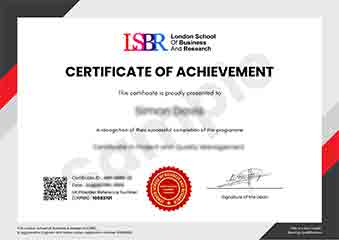
Sample Certificate
Preview the certificate you'll receive upon successful completion of this program.
Get Course Info
Receive the full course guide, pricing details, and enrolment instructions directly in your inbox.
Check your inbox!
Course details have been sent to your email.
Get Your Employer to Sponsor This Programme
Many employers offer professional development budgets. We make it easy for your company to invest in your growth with corporate invoicing and bulk enrolment options.
Email Template for Your Manager
Dear [Manager's Name],
I would like to request sponsorship for the Professional Certificate in Harmonic Analysis for Signal Processing programme offered by LSBR London - Executive Education.
The programme costs $149 (one-time) and can be completed in 3-4 weeks alongside my regular duties.
Key benefits to our team:
- Immediately applicable skills
- Globally recognised certificate
- Corporate invoice available
Best regards,
[Your Name]
What Our Students Say
Hear from our students about their experience with the Professional Certificate in Harmonic Analysis for Signal Processing at LSBR London - Executive Education.
Sophie Brown
United Kingdom"The course material provided a rigorous yet accessible deep dive into Fourier transforms and spectral analysis, bridging the gap between abstract theory and real-world application. I now feel confident applying these harmonic analysis techniques to filter noise and extract meaningful features from complex signal datasets in my engineering projects."
Greta Fischer
Germany"Mastering the mathematical foundations of harmonic analysis transformed my ability to design efficient signal processing algorithms for real-time audio applications. This deep technical expertise directly accelerated my promotion to a senior engineering role, where I now lead projects requiring advanced spectral analysis."
Charlotte Williams
United Kingdom"The logical progression from foundational Fourier concepts to advanced spectral estimation made complex signal processing techniques feel intuitive and manageable. This structured approach significantly enhanced my ability to apply harmonic analysis in real-world engineering scenarios, directly boosting my professional confidence."
Your Certification Journey
Four simple steps from enrolment to your globally recognised certificate
Enrol Online
Complete your enrolment in under 2 minutes with secure checkout
Start Learning
Get instant access to all course materials and start at your own pace
Complete Modules
Work through the curriculum with expert support available throughout
Get Certified
Receive your LSBR London certificate recognised across 180+ countries
LSBR London by the Numbers
Join a global community of professionals advancing their careers
Students Enrolled
Countries Represented
Average Rating
Career Progression