
Undergraduate Certificate in Algebraic Structures in Signal Processing
Master algebraic techniques to enhance signal processing skills, enabling advanced innovation and career advancement in modern technology sectors.
Undergraduate Certificate in Algebraic Structures in Signal Processing
Programme Summary
This rigorous undergraduate certificate targets mathematics and engineering students seeking to master the application of abstract algebraic frameworks to modern signal processing challenges. The curriculum delves into group theory, ring structures, and theory, explicitly linking these mathematical constructs to discrete signal analysis and spectral decomposition. Participants engage with advanced computational techniques that utilise algebraic invariants to solve complex problems in data compression and noise reduction. The programme demands a strong foundation in linear algebra and calculus, ensuring that only candidates with proven quantitative proficiency undertake this specialised study.
Learners acquire the ability to model non-linear signal transformations using finite field arithmetic and polynomial ring operations. Students develop proficiency in implementing algebraic algorithms for efficient convolution and correlation tasks within high-dimensional data spaces. The coursework emphasises the derivation of robust error-correcting codes based on cyclic group properties, directly enhancing data integrity in noisy communication channels. Participants also master the use of symbolic computation software to verify algebraic identities and optimise signal processing pipelines for real-time applications.
Graduates emerge equipped to lead research and development initiatives in telecommunications, radar systems, and digital audio engineering. The credential signals to employers a rare capability to bridge theoretical mathematics with practical engineering constraints. Alumni typically secure roles as signal processing engineers, algorithm designers, or data scientists within leading technology firms and defence contractors. This qualification accelerates career progression by providing the sophisticated analytical tools required to innovate in next-generation communication standards and secure data transmission protocols.
Learning Outcomes
This rigorous Undergraduate Certificate equips students with the mathematical sophistication required to navigate the complexities of modern signal processing. By bridging the gap between abstract algebraic theory and practical engineering applications, the programme offers a distinctive competitive advantage in the technology sector. Candidates gain a profound understanding of how algebraic structures underpin efficient data transmission, compression, and analysis, ensuring they are prepared for high-stakes technical challenges.
The curriculum centres on finite fields, group theory, and ring structures, examining their direct application to error-correcting codes, cryptographic systems, and spectral analysis. Students engage with complex modules on linear algebraic methods for multidimensional signal processing and the algebraic foundations of wavelet transforms. This theoretical framework is reinforced through intensive computational laboratories, where learners utilise advanced software to simulate real-world scenarios. Such hands-on experience ensures that graduates can translate abstract mathematical concepts into robust, scalable engineering solutions.
Professionals completing this certificate possess a rare skill set that combines deep mathematical insight with practical signal processing expertise. They are uniquely positioned to optimise communication protocols, enhance image recognition algorithms, and develop secure data transmission systems. Employers across the telecommunications, aerospace, and financial technology industries highly value this specialised knowledge. Graduates frequently secure roles as signal processing engineers, algorithm developers, or research scientists within leading global corporations and academic institutions. The programme also serves as an excellent foundation for postgraduate study, opening doors to advanced research in digital communications and information theory. By mastering these algebraic tools, students not
Programme Features
Industry-Aligned Curriculum
Developed with industry leaders for job-ready skills
Globally Recognised Certificate
Recognised by employers across 180+ countries
Flexible Online Learning
Study at your own pace with lifetime access
Instant Access
Start learning immediately, no application process
Constantly Updated Content
Latest industry trends and best practices
Career Advancement
87% report measurable career progression within 6 months
Course Modules
- Linear Algebra for Signals: Introduces vector spaces, matrices, and eigenvalues essential for signal representation.: Abstract Algebra Foundations: Covers groups, rings, and fields to establish the mathematical language of algebraic structures.
- Fourier Analysis and Duality: Examines the discrete Fourier transform and its algebraic properties in frequency domain analysis.: Convolution and Polynomial Rings: Explores the relationship between signal convolution and operations within polynomial rings.
- Finite Fields in Coding Theory: Applies Galois field arithmetic to error detection and correction in digital signal transmission.: Multirate Signal Processing: Utilizes algebraic techniques to analyze decimation, interpolation, and filter bank structures.
What's Included in This Programme
Here is what you get when you enrol with LSBR London
Programme Facts
Audience: Aspiring engineers seeking advanced mathematical proficiency.
Prerequisites: Bachelor degree in mathematics or engineering.
Outcomes: Mastery of algebraic signal processing techniques.
Ready to advance your career?
Join thousands of professionals who have transformed their careers with LSBR London. Enrol today and start learning immediately.
Why Study This Programme
Pursuing an Undergraduate Certificate in Algebraic Structures in Signal Processing offers a rigorous foundation for engineers seeking to transcend conventional methodologies. This qualification equips practitioners with the mathematical maturity required to address complex, non-linear challenges in modern telecommunications and data analytics.
The curriculum fosters advanced algorithmic design capabilities. By mastering group theory and ring structures, graduates can develop more efficient compression and encryption protocols. This technical proficiency directly translates into reduced computational overhead and enhanced security architectures, making candidates highly attractive to defence contractors and leading telecommunications firms.
Professionals gain a distinct competitive advantage in emerging fields such as quantum computing. Understanding the algebraic underpinnings of signal transformation allows engineers to anticipate and adapt to next-generation hardware requirements. This forward-looking expertise ensures long-term career relevance in an industry undergoing rapid technological obsolescence.
The programme cultivates rigorous analytical reasoning. Students learn to abstract complex physical phenomena into manageable mathematical models. This skill set is invaluable for roles in research and development, where the ability to deconstruct ambiguous problems into solvable components is paramount. Employers value this capacity for high-level strategic thinking and innovation.
Graduates demonstrate a commitment to continuous professional development. Completing this specialised certificate signals intellectual curiosity and technical depth to potential employers. It distinguishes candidates in a saturated job market, often leading to accelerated promotion trajectories and access to senior technical leadership positions within multinational corporations.
"This programme gave me the confidence and credentials to secure a senior role. Highly recommend LSBR London."
— Sarah M., United Kingdom
Course Brochure
Download our comprehensive course brochure with all details
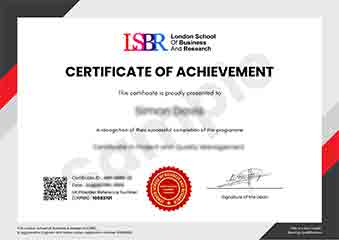
Sample Certificate
Preview the certificate you'll receive upon successful completion of this program.
Get Course Info
Receive the full course guide, pricing details, and enrolment instructions directly in your inbox.
Check your inbox!
Course details have been sent to your email.
Get Your Employer to Sponsor This Programme
Many employers offer professional development budgets. We make it easy for your company to invest in your growth with corporate invoicing and bulk enrolment options.
Email Template for Your Manager
Dear [Manager's Name],
I would like to request sponsorship for the Undergraduate Certificate in Algebraic Structures in Signal Processing programme offered by LSBR London - Executive Education.
The programme costs $99 (one-time) and can be completed in 3-4 weeks alongside my regular duties.
Key benefits to our team:
- Immediately applicable skills
- Globally recognised certificate
- Corporate invoice available
Best regards,
[Your Name]
What Our Students Say
Hear from our students about their experience with the Undergraduate Certificate in Algebraic Structures in Signal Processing at LSBR London - Executive Education.
James Thompson
United Kingdom"The rigorous focus on applying abstract algebraic concepts to real-world signal processing problems bridged a critical gap in my technical understanding. Mastering these structural frameworks has significantly enhanced my ability to design efficient algorithms for complex data analysis tasks."
Sophie Brown
United Kingdom"Mastering the algebraic frameworks for signal decomposition has directly enhanced my ability to optimize compression algorithms in my current role. This specialized knowledge bridged the gap between theoretical math and real-world engineering challenges, leading to a significant promotion within my R&D team."
Ryan MacLeod
Canada"The logical progression of topics made complex algebraic concepts accessible and directly applicable to signal processing challenges. This structured approach significantly enhanced my ability to analyze and design efficient algorithms for real-world engineering problems."
Your Certification Journey
Four simple steps from enrolment to your globally recognised certificate
Enrol Online
Complete your enrolment in under 2 minutes with secure checkout
Start Learning
Get instant access to all course materials and start at your own pace
Complete Modules
Work through the curriculum with expert support available throughout
Get Certified
Receive your LSBR London certificate recognised across 180+ countries
LSBR London by the Numbers
Join a global community of professionals advancing their careers
Students Enrolled
Countries Represented
Average Rating
Career Progression