
Undergraduate Certificate in Black Hole Simulation and Analysis
Master black hole simulation and analysis fundamentals for professional excellence. Create pathways to career success.
Undergraduate Certificate in Black Hole Simulation and Analysis
Programme Summary
The Undergraduate Certificate in Black Hole Simulation and Analysis provides rigorous training in computational astrophysics, targeting final-year physics or mathematics students seeking specialisation in high-energy phenomena. This intensive curriculum bridges theoretical general relativity with practical numerical methods, ensuring participants master the complex algorithms required to model spacetime curvature and gravitational wave emissions. Learners engage directly with state-of-the-art supercomputing facilities to simulate binary black hole mergers, thereby gaining essential experience in handling large-scale scientific datasets. The programme demands a strong foundation in differential equations and linear algebra, preparing candidates for advanced research environments where precision and computational efficiency remain paramount.
Participants acquire proficiency in parallel computing frameworks such as MPI and OpenMP, enabling them to execute complex simulations across distributed clusters. Students develop expertise in visualising four-dimensional spacetime dynamics, translating abstract mathematical solutions into interpretable graphical representations for peer review and publication. The course emphasises critical analysis of numerical stability and error propagation, ensuring that simulation results meet the stringent accuracy standards required by modern observational astronomy. Learners also gain fluency in Python and C++ programming languages, which are indispensable tools for developing custom astrophysical codes and integrating with existing scientific software libraries.
Graduates emerge as highly competitive candidates for PhD positions in theoretical physics and data science roles within national research laboratories. The certificate distinguishes holders in the academic job market by demonstrating verified capability in handling the computational challenges inherent in multi-messenger astronomy. Industry sectors requiring advanced algorithmic development and high-performance computing actively recruit graduates with
Learning Outcomes
The Undergraduate Certificate in Black Hole Simulation and Analysis offers a rigorous, interdisciplinary exploration of the most extreme phenomena in the observable universe. This programme distinguishes itself by bridging the gap between theoretical astrophysics and high-performance computational modelling, equipping students with the technical proficiency required to navigate the frontiers of modern cosmology. Participants engage directly with the complexities of general relativity, learning to simulate accretion disks, event horizons, and gravitational wave signatures using state-of-the-art numerical tools.
Curriculum focus remains firmly on practical application. Students master parallel computing architectures, Python-based scientific libraries, and data visualisation techniques essential for processing terabytes of observational data from facilities such as LIGO and the Event Horizon Telescope. The coursework demands precision, encouraging learners to construct robust simulations that test hypotheses regarding black hole mergers and information paradoxes. Such hands-on experience ensures that graduates possess not only theoretical understanding but also the computational fluency prized by leading research institutions.
Upon completion, alumni find themselves well-positioned for diverse career trajectories. Many proceed to postgraduate research in astrophysics or theoretical physics, contributing to global collaborations that decode the origins of the cosmos. Others transition into the burgeoning data science sector, where their expertise in handling large-scale, complex datasets proves invaluable in finance, healthcare, and artificial intelligence. The analytical rigour developed through simulating chaotic gravitational systems translates seamlessly into roles requiring advanced predictive modelling and problem-solving.
This certificate serves as a gateway for ambitious undergraduates seeking
Programme Features
Industry-Aligned Curriculum
Developed with industry leaders for job-ready skills
Globally Recognised Certificate
Recognised by employers across 180+ countries
Flexible Online Learning
Study at your own pace with lifetime access
Instant Access
Start learning immediately, no application process
Constantly Updated Content
Latest industry trends and best practices
Career Advancement
87% report measurable career progression within 6 months
Course Modules
- General Relativity Fundamentals: Introduces Einstein’s field equations and the geometric nature of spacetime.: Numerical Relativity Basics: Teaches discretization methods for solving complex gravitational equations.
- Black Hole Formation Dynamics: Examines the gravitational collapse of massive stars into singularities.: Waveform Generation Techniques: Focuses on creating accurate gravitational wave templates for detection.
- Data Analysis and Detection: Covers signal processing and statistical methods for identifying events.: Advanced Simulation Case Studies: Analyzes recent merger events and multi-messenger astronomy results.
What's Included in This Programme
Here is what you get when you enrol with LSBR London
Programme Facts
Audience: Advanced undergraduates pursuing computational astrophysics.
Prerequisites: Strong mathematical and programming foundations.
Outcomes: Master numerical relativity techniques effectively.
Ready to advance your career?
Join thousands of professionals who have transformed their careers with LSBR London. Enrol today and start learning immediately.
Why Study This Programme
The Undergraduate Certificate in Black Hole Simulation and Analysis offers a compelling pathway for professionals seeking to distinguish themselves in the forefront of computational astrophysics and high-performance computing. This rigorous programme addresses the growing demand for specialists capable of interpreting complex gravitational data, thereby enhancing employability across both academic research institutions and private-sector technology firms.
Mastery of Advanced Computational Techniques: Candidates acquire proficiency in general relativistic hydrodynamics and numerical relativity. These skills are directly transferable to industries requiring robust simulation environments, such as aerospace engineering and financial modelling, where predictive accuracy is paramount.
Enhanced Data Analytics Capability: The curriculum emphasises the processing of large-scale datasets generated by observatories like LIGO and Virgo. Professionals develop sophisticated statistical methods to extract signal from noise, a competency highly valued in data science roles that demand precision under uncertainty.
Interdisciplinary Collaboration Experience: Participants engage in simulated multi-messenger astronomy projects, fostering essential teamwork skills across physics, computer science, and mathematics. This exposure prepares graduates for collaborative environments typical of modern research consortia and corporate R&D departments.
Strategic Insight into Emerging Technologies: By engaging with cutting-edge algorithms and machine learning applications in astrophysics, professionals gain early exposure to technologies likely to disrupt other sectors. This forward-looking perspective enables strategic career planning and positions candidates as innovators within their respective fields.
Enrolling in this certificate demonstrates a commitment to intellectual rigour and technical excellence, significantly boosting professional credibility and opening doors to specialised
"This programme gave me the confidence and credentials to secure a senior role. Highly recommend LSBR London."
— Sarah M., United Kingdom
Course Brochure
Download our comprehensive course brochure with all details
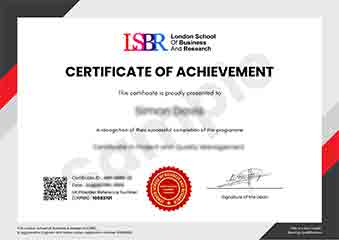
Sample Certificate
Preview the certificate you'll receive upon successful completion of this program.
Get Course Info
Receive the full course guide, pricing details, and enrolment instructions directly in your inbox.
Check your inbox!
Course details have been sent to your email.
Get Your Employer to Sponsor This Programme
Many employers offer professional development budgets. We make it easy for your company to invest in your growth with corporate invoicing and bulk enrolment options.
Email Template for Your Manager
Dear [Manager's Name],
I would like to request sponsorship for the Undergraduate Certificate in Black Hole Simulation and Analysis programme offered by LSBR London - Executive Education.
The programme costs $99 (one-time) and can be completed in 3-4 weeks alongside my regular duties.
Key benefits to our team:
- Immediately applicable skills
- Globally recognised certificate
- Corporate invoice available
Best regards,
[Your Name]
What Our Students Say
Hear from our students about their experience with the Undergraduate Certificate in Black Hole Simulation and Analysis at LSBR London - Executive Education.
Oliver Davies
United Kingdom"The course material was exceptionally clear and up‑to‑date, giving me a solid grounding in relativistic physics, numerical methods, and data visualization specific to black hole simulations. I left with hands‑on experience building and analyzing high‑resolution models, which has already proven valuable in my research assistant role and future career prospects."
Ruby McKenzie
Australia"The hands‑on experience with relativistic fluid dynamics and GPU‑accelerated modeling gave me the exact skill set employers look for in aerospace and defense R&D, and I landed a junior simulation engineer role within weeks of graduating. This certificate also helped me translate complex gravitational wave data into actionable insights, opening doors to collaborative projects with leading research labs."
Hans Weber
Germany"The course’s modular layout made it easy to progress from basic relativistic concepts to advanced simulation techniques, and each unit built logically on the last. The comprehensive content, packed with real-world astrophysical case studies, gave me a solid foundation that I can directly apply to research and industry projects."
Your Certification Journey
Four simple steps from enrolment to your globally recognised certificate
Enrol Online
Complete your enrolment in under 2 minutes with secure checkout
Start Learning
Get instant access to all course materials and start at your own pace
Complete Modules
Work through the curriculum with expert support available throughout
Get Certified
Receive your LSBR London certificate recognised across 180+ countries
LSBR London by the Numbers
Join a global community of professionals advancing their careers
Students Enrolled
Countries Represented
Average Rating
Career Progression