
Undergraduate Certificate in Mathematical Modeling with Interactive Tools
Gain practical modeling skills, master interactive software, and solve real‑world problems, enhancing employability and interdisciplinary
Undergraduate Certificate in Mathematical Modeling with Interactive Tools
Programme Summary
The Undergraduate Certificate in Mathematical Modeling with Interactive Tools provides a rigorous foundation in quantitative analysis for students seeking to bridge theoretical mathematics and practical application. This programme targets undergraduates from diverse disciplines who require robust analytical capabilities to interpret complex data sets within their respective fields. Participants engage with contemporary software environments, including Python and R, to construct dynamic models that simulate real-world phenomena with precision. The curriculum integrates linear algebra, calculus, and statistical inference, ensuring learners possess the mathematical maturity necessary for advanced computational tasks. By focusing on interactive visualization techniques, the course enables students to translate abstract equations into actionable insights for decision-making processes.
Learners develop proficiency in algorithmic thinking, enabling them to design efficient computational solutions for multidimensional problems. The coursework emphasizes the creation of reproducible research pipelines, a critical competency in modern data science and engineering sectors. Students master the art of sensitivity analysis, allowing them to evaluate how variations in input parameters affect model outputs and overall system stability. Training in interactive dashboard development equips participants to communicate technical findings effectively to non-specialist audiences through intuitive graphical interfaces. This dual focus on technical rigour and communicative clarity ensures graduates can navigate both the development and presentation stages of complex analytical projects.
Completion of this certificate significantly enhances employability in industries reliant on data-driven strategies, such as finance, logistics, and public policy. Employers value candidates who can independently formulate mathematical frameworks to address operational challenges and optimize resource allocation. Graduates demonstrate the ability to integrate quantitative methods into strategic planning,
Learning Outcomes
This rigorous undergraduate certificate equips students with the analytical rigour and technical proficiency required to translate complex real-world phenomena into robust mathematical frameworks. In an era defined by data abundance, the ability to construct, validate, and interpret models is a critical competency for strategic decision-making across diverse sectors. The curriculum integrates foundational theoretical concepts with advanced interactive computational tools, ensuring learners gain immediate, practical experience in simulation and visualisation.
Participants engage deeply with differential equations, stochastic processes, and optimisation techniques, applying these methods to tangible challenges in finance, logistics, and public health. The programme emphasises the use of industry-standard software such as Python, R, and MATLAB, fostering a hands-on learning environment where abstract theory meets practical application. Students develop the capacity to manipulate variables, observe dynamic system behaviours, and refine models based on empirical feedback, thereby cultivating a nuanced understanding of uncertainty and risk.
Graduates emerge with a distinctive skill set that bridges the gap between pure mathematics and operational strategy. They are prepared to drive innovation by identifying inefficiencies, forecasting trends, and designing evidence-based solutions. Employers value these individuals for their ability to communicate complex quantitative insights clearly to non-technical stakeholders, a vital trait in collaborative professional environments.
Career pathways span a broad spectrum of high-impact roles, including quantitative analyst, data scientist, operations researcher, and systems engineer. Alumni frequently secure positions within leading financial institutions, technology firms, and consulting agencies, where their modelling expertise directly influences product development and strategic planning. This
Programme Features
Industry-Aligned Curriculum
Developed with industry leaders for job-ready skills
Globally Recognised Certificate
Recognised by employers across 180+ countries
Flexible Online Learning
Study at your own pace with lifetime access
Instant Access
Start learning immediately, no application process
Constantly Updated Content
Latest industry trends and best practices
Career Advancement
87% report measurable career progression within 6 months
Course Modules
- Introduction to Mathematical Modeling: Explores the fundamental principles of translating real-world problems into mathematical frameworks.: Computational Tools and Syntax: Introduces interactive software environments and basic programming syntax for numerical computation.
- Differential Equations and Dynamics: Models continuous change using ordinary differential equations and phase plane analysis.: Discrete Structures and Combinatorics: Applies graph theory and discrete mathematics to model networks and logical systems.
- Data Analysis and Statistical Modeling: Integrates probability theory and statistical inference to analyze empirical data sets.: Capstone Project and Visualization: Synthesizes learned skills to develop a comprehensive model with interactive visual outputs.
What's Included in This Programme
Here is what you get when you enrol with LSBR London
Programme Facts
Audience: Aspiring data scientists and quantitative analysts.
Prerequisites: A solid foundation in calculus.
Outcomes: Master dynamic modelling via interactive software.
Ready to advance your career?
Join thousands of professionals who have transformed their careers with LSBR London. Enrol today and start learning immediately.
Why Study This Programme
The Undergraduate Certificate in Mathematical Modeling with Interactive Tools offers a strategic advantage for professionals seeking to enhance their analytical capabilities. This programme bridges the gap between theoretical mathematics and practical application, ensuring graduates remain competitive in data-driven industries.
Enhanced Decision-Making Capabilities: Participants acquire the ability to construct robust models that simulate complex real-world scenarios. This skillset enables leaders to forecast outcomes with greater precision, thereby reducing risk and optimising resource allocation within their organisations.
Mastery of Industry-Standard Software: The curriculum emphasises proficiency in interactive computational tools such as MATLAB and Python. Such technical fluency allows professionals to automate repetitive analytical tasks, freeing up valuable time for strategic planning and high-level problem solving.
Improved Data Communication Skills: Learners develop the competence to translate intricate mathematical findings into clear, actionable insights for non-technical stakeholders. This ability to bridge the divide between data science and business strategy is increasingly prized by senior management teams.
Adaptability in Evolving Markets: By understanding the underlying logic of algorithmic processes, professionals become better equipped to navigate rapid technological shifts. This foundational knowledge ensures long-term career resilience amidst the growing demand for quantitative expertise across sectors.
Pursuing this certificate demonstrates a commitment to continuous professional development, positioning candidates as forward-thinking leaders capable of leveraging data for sustained organisational success.
"This programme gave me the confidence and credentials to secure a senior role. Highly recommend LSBR London."
— Sarah M., United Kingdom
Course Brochure
Download our comprehensive course brochure with all details
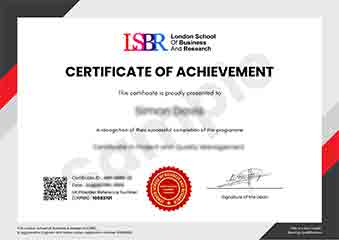
Sample Certificate
Preview the certificate you'll receive upon successful completion of this program.
Get Course Info
Receive the full course guide, pricing details, and enrolment instructions directly in your inbox.
Check your inbox!
Course details have been sent to your email.
Get Your Employer to Sponsor This Programme
Many employers offer professional development budgets. We make it easy for your company to invest in your growth with corporate invoicing and bulk enrolment options.
Email Template for Your Manager
Dear [Manager's Name],
I would like to request sponsorship for the Undergraduate Certificate in Mathematical Modeling with Interactive Tools programme offered by LSBR London - Executive Education.
The programme costs $99 (one-time) and can be completed in 3-4 weeks alongside my regular duties.
Key benefits to our team:
- Immediately applicable skills
- Globally recognised certificate
- Corporate invoice available
Best regards,
[Your Name]
What Our Students Say
Hear from our students about their experience with the Undergraduate Certificate in Mathematical Modeling with Interactive Tools at LSBR London - Executive Education.
James Thompson
United Kingdom"The course material was exceptionally clear and well‑structured, covering everything from differential equations to data visualization with modern interactive tools. I left with hands‑on experience building and analyzing real‑world models, which has already helped me contribute more effectively to research projects and feel confident about applying these techniques in an industry setting."
Oliver Davies
United Kingdom"The certificate gave me a solid toolbox of differential equations, data‑driven simulation, and interactive visualization that I could immediately apply to real‑world projects, and I now confidently lead modeling initiatives in my company's sustainability team. Since completing the program, I’ve been promoted to a senior analyst role and regularly consult on cross‑functional optimization problems, proving the course’s direct relevance to industry needs."
Wei Ming Tan
Singapore"The course’s modular layout made it easy to progress from foundational theory to advanced modeling techniques, and each unit built logically on the last. I especially appreciated how the content blended rigorous mathematics with interactive tools, giving me practical skills I can apply directly to real‑world problems and future professional projects."
Your Certification Journey
Four simple steps from enrolment to your globally recognised certificate
Enrol Online
Complete your enrolment in under 2 minutes with secure checkout
Start Learning
Get instant access to all course materials and start at your own pace
Complete Modules
Work through the curriculum with expert support available throughout
Get Certified
Receive your LSBR London certificate recognised across 180+ countries
LSBR London by the Numbers
Join a global community of professionals advancing their careers
Students Enrolled
Countries Represented
Average Rating
Career Progression