
Undergraduate Certificate in Python NLTK for Advanced Text Classification
Gain advanced skills in text classification using Python's NLTK library, enhancing your data science and natural language processing capabilities.
Undergraduate Certificate in Python NLTK for Advanced Text Classification
Programme Overview
This course is for you if you are a student or professional aiming to enhance your Python skills with a focus on advanced text classification. You will gain a strong foundation in Natural Language Toolkit (NLTK). First, you will dive into the basics of NLTK. Next, you will master techniques for preprocessing text data. You will also learn to build and evaluate models for text classification tasks.
Consequently, you will apply your skills through hands-on projects. You will work with real-world datasets, gaining practical experience. Additionally, you will explore advanced topics such as sentiment analysis and topic modeling. Finally, you will receive a certificate upon completion, which can be a valuable addition to your resume.
What You'll Learn
Unlock the power of language with our Undergraduate Certificate in Python NLTK for Advanced Text Classification.
First, dive into the world of Natural Language Processing (NLP). Then, master Python’s NLTK library. Next, harness the power of machine learning. You'll develop advanced text classification skills. These skills are crucial for understanding, interpreting, and predicting patterns in large data sets.
Benefits:
Real-world applications: Apply your new skills to social media sentiment analysis.
In-demand skills: Join a growing industry of data scientists and analysts.
Hands-on experience: Work on projects that simulate real-world scenarios.
Career Opportunities:
Data Scientist
NLP Engineer
Text Analyst
Machine Learning Specialist
So, why wait? Take the first step towards a rewarding career in text analysis. Enroll today and transform your future!
Programme Highlights
Industry-Aligned Curriculum
Developed with industry leaders to ensure practical, job-ready skills valued by employers worldwide.
Expert Faculty
Learn from experienced professionals with real-world expertise in your chosen field.
Flexible Learning
Study at your own pace, from anywhere in the world, with our flexible online platform.
Industry Focus
Practical, real-world knowledge designed to meet the demands of today's competitive job market.
Latest Curriculum
Stay ahead with constantly updated content reflecting the latest industry trends and best practices.
Career Advancement
Unlock new opportunities with a globally recognized qualification respected by employers.
Topics Covered
- Introduction to Python and NLTK: Learn the basics of Python programming and the Natural Language Toolkit (NLTK) library.
- Text Preprocessing Techniques: Understand and implement various text preprocessing methods using NLTK.
- Feature Extraction for Text Data: Explore techniques to extract meaningful features from text data for classification.
- Supervised Learning Algorithms: Study and apply supervised machine learning algorithms for text classification.
- Model Evaluation and Optimization: Learn methods to evaluate and optimize text classification models.
- Advanced Topics in Text Classification: Delve into advanced techniques and current trends in text classification.
Key Facts
Firstly, the Audience for this certificate includes anyone eager to master advanced text classification using Python and the Natural Language Toolkit (NLTK). Therefore, it welcomes learners from diverse backgrounds, such as students, professionals, and enthusiasts in data science.
Next, Prerequisites are minimal. However, you should have basic Python programming skills and familiarity with fundamental text processing concepts. Moreover, you need a computer with internet access and the willingness to learn.
Lastly, Outcomes of this program include the ability to preprocess text data effectively. Additionally, you will learn to build and evaluate advanced text classification models. Finally, you will gain hands-on experience with Python and NLTK, enabling you to tackle real-world text classification challenges.
Why This Course
Learners should pick 'Undergraduate Certificate in Python NLTK for Advanced Text Classification'. First, this program equips users with powerful tools. Secondly, it enhances your ability to handle complex text data. Finally, it opens doors to various career paths. In addition, it provides hands-on experience. Moreover, it fosters a community of learners.
Programme Title
Undergraduate Certificate in Python NLTK for Advanced Text Classification
Course Brochure
Download our comprehensive course brochure with all details
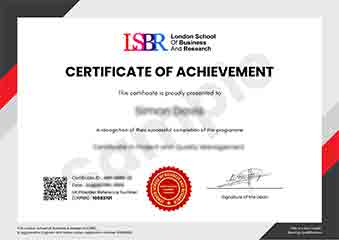
Sample Certificate
Preview the certificate you'll receive upon successful completion of this program.
Pay as an Employer
Request an invoice for your company to pay for this course. Perfect for corporate training and professional development.
What People Say About Us
Hear from our students about their experience with the Undergraduate Certificate in Python NLTK for Advanced Text Classification at LSBR London - Executive Education.
James Thompson
United Kingdom"The course content was incredibly comprehensive, diving deep into Python and NLTK for text classification, which has significantly enhanced my ability to work with natural language data. The practical skills I've gained, such as building and evaluating text classifiers, have already proven valuable in my internship and will undoubtedly benefit my future career in data science."
Greta Fischer
Germany"This course has been a game-changer for me. I've gained hands-on experience with Python NLTK that is directly applicable to real-world text classification problems, making me more competitive in the job market. The skills I've developed have already led to a promotion at my current job, where I now lead projects involving natural language processing."
Greta Fischer
Germany"The course structure was exceptionally well-organized, with a clear progression from basic to advanced topics in Python NLTK, which made it easy to follow and understand. The comprehensive content not only covered theoretical aspects but also provided practical examples and real-world applications, significantly enhancing my professional growth in text classification."